
OVERVIEW
In the Fashion Management and Communication course, International Certification, students are prepared to work across a range of areas in the fashion industry, including design management, production management, and fashion communication and marketing.
Fashion is a cultural expression that goes far beyond personal style. It is also a social and political statement, shaped by creativity, choice, and awareness, within an industry that is constantly evolving.
Throughout the programme, students develop the confidence to make innovative, informed decisions, whether launching their own projects or working as part of a fashion brand management team. Students gain the skills to successfully position a brand, a collection, or a single product within competitive fashion markets.
LEARNING METHODOLOGY
The School’s teaching is based on a project-based learning (PBL) approach, delivered in small classes of up to 18 students, ensuring close student-teacher interaction. Students learn by seeking solutions to real-world challenges, often working in teams, fostering their creative, critical, and personal development.
TEACHERS
The teaching staff is composed of active industry professionals, and students are encouraged to participate regularly in workshops, conferences, and study visits to enhance their knowledge and gain exposure to real-world professional environments.
PROGRAMME
This unit focuses on understanding fashion as a cultural phenomenon. It explores the main theories and concepts related to fashion and fashion imagery, through their historical, social, and cultural context in the 20th century.
This unit focuses on the strategic management of fashion businesses. It addresses human resource management approaches, as well as sales, retail, and product distribution strategies across physical points of sale and digital platforms, including e-commerce.
This unit presents the core pillars of fashion marketing, introducing fundamental concepts such as market analysis, consumer behavior, and brand strategy. It also explores branding principles and examines how fashion brands create distinctive and engaging brand experiences.
This unit outlines the key stages involved in developing a fashion brand communication strategy, supporting its implementation through the use of digital communication design tools for fashion.
This unit introduces the principles of production management within the fashion industry. It explores the main communication tools used to engage stakeholders, outlines the key processes of the fashion production chain, and highlights the growing importance of sustainability in contemporary fashion brands.
In Project I, students apply research methodologies and creative processes to develop a fashion brand communication strategy based on a professional briefing.
In Project II, students explore the creation of fashion imagery, focusing on the planning, production, and supervision of professional fashion photoshoots.
This laboratory seeks to unify connections within the community. It is a meeting point and an exchange space dedicated to creativity, where interdisciplinary practices are explored both inside and outside the school environment. Communication is central to this process. The lab aims to identify and mobilize trends, experiment with new ways of thinking and conceptualizing, and facilitate synergies among students – a true learning tool.
Our courses share content and present challenges with an international perspective. We prepare and support our students based on best practices, regardless of geography or nationality. For this reason, knowing English is a fundamental tool for breaking down barriers: gaining access to more references, discovering more professional contexts, and developing a portfolio in line with the best work being produced, without borders.
This unit prepares students for a successful transition into the labor market by introducing personal marketing strategies. It focuses on self-promotion, personal branding, self-assessment, and the definition of career goals.
This unit explores the mechanisms of fashion trends and their impact on the innovation strategies of fashion brands. It also examines digital marketing practices, including social media and influencer marketing strategies within the contemporary fashion industry.
The Fashion Communication II unit provides an in-depth exploration of strategies for creating fashion imagery across both online and offline platforms. It examines fashion production, styling practices, and artistic experimentation within the broader context of visual communication in fashion.
This unit covers the legal and financial aspects of a fashion brand. It introduces methods for planning and managing business processes, analyzes fashion business models, and explores logistics strategies and the internationalization of fashion brands.
In the Project III unit, the practice of art direction in fashion design is explored, focusing on the creation of images and visual messaging.
In the Project IV unit, events in the context of fashion are introduced, highlighting how they respond to cultural contexts and social trends. Students engage with the full planning and organization process, culminating in the execution of a fashion-related communication event.
The objective is to prepare students for the project-driven dynamics of the creative industries, encourage teamwork, promote interdisciplinarity, foster a sense of responsibility and goal achievement, and develop personal presentation and self-promotion skills. In this way, the school environment is brought closer to the reality of the professional world and its demands.
CERTIFICATION
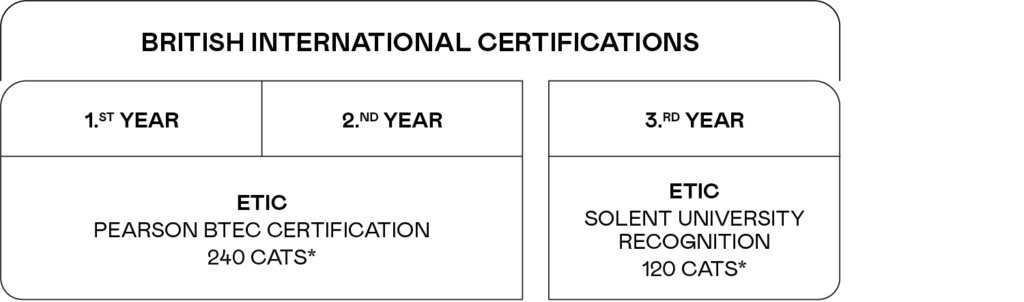
At the end of the second year, students receive the Pearson BTEC Level 5 Professional Certification (240 CATS*).
Certification follows the British education system; ETIC is not a higher education institution.
*CATS: Credit Accreditation Transfer System
TEACHING STAFF
MARTA CORDEIRO
Coordinator
MARTA CORDEIRO
Fashion Marketeer, Consultant.
Bachelor’s degree in Marketing and Advertising and a postgraduate degree in Strategic Marketing. She has over 20 years of professional experience in Marketing, having worked with international fashion brands such as Lacoste, Sacoor, and Bimba y Lola. She has been teaching for 14 years and is the creator and coordinator of Fashion Marketing programmes, combining hands-on industry experience with academic training.
Learn more
LUÍS EMÍLIO
Tutor
LUÍS EMÍLIO
Fashion Designer, Producer.
He holds a degree in Fashion Design from Modatex Lisbon, completed in 2014. Luís Emílio has six years of professional experience as a Fashion Designer in the Research & Development and Innovation Department, where he developed in-depth knowledge of the Textile and Apparel Sector, with a strong focus on technical and industrial processes.
Throughout his professional career, he has collaborated with leading international trade fairs such as Première Vision Paris, Munich Fabric Start, ISPO Munich, and JITAC Japan, as well as with national clients. Notably, he contributed to the design and development of the current uniform for EMEL – Lisbon’s Municipal Mobility and Parking Company.
He has been teaching at ETIC since 2020, delivering courses in the field of Fashion with a technical and industrial focus, and adopting a hands-on approach aligned with the real demands of the labor market.
Learn more
DORA NOBRE
MARTA CORDEIRO
Teacher
MARTA CORDEIRO
Fashion Marketeer, Consultant.
Bachelor’s degree in Marketing and Advertising and a postgraduate degree in Strategic Marketing. She has over 20 years of professional experience in Marketing, having worked with international fashion brands such as Lacoste, Sacoor, and Bimba y Lola. She has been teaching for 14 years and is the creator and coordinator of Fashion Marketing programmes, combining hands-on industry experience with academic training.
PATRÍCIA DE SÁ OLIVEIRA
Teacher
PATRÍCIA DE SÁ OLIVEIRA
Producer and Creative Fashion Director.
With a passion for fashion and over 15 years of professional experience, she is a Creative Director at the production company Fora de Serviço, where she transforms concepts into memorable visual experiences. From backstage production to styling, casting, and image consultancy, her professional practice is driven by the mission to strengthen brands and individuals through creativity, strategic thinking, and authenticity.
LUÍS EMÍLIO
Teacher
LUÍS EMÍLIO
Fashion Designer, Producer.
He holds a degree in Fashion Design from Modatex Lisbon, completed in 2014. Luís Emílio has six years of professional experience as a Fashion Designer in the Research & Development and Innovation Department, where he developed in-depth knowledge of the Textile and Apparel Sector, with a strong focus on technical and industrial processes.
Throughout his professional career, he has collaborated with leading international trade fairs such as Première Vision Paris, Munich Fabric Start, ISPO Munich, and JITAC Japan, as well as with national clients. Notably, he contributed to the design and development of the current uniform for EMEL – Lisbon’s Municipal Mobility and Parking Company.
He has been teaching at ETIC since 2020, delivering courses in the field of Fashion with a technical and industrial focus, and adopting a hands-on approach aligned with the real demands of the labor market.
ALINE MACEDO
Teacher
ALINE MACEDO
Photography and Communication.
She is a photographer and visual researcher whose practice integrates identity, strategy, and sensibility. She holds a degree in Literature, a Master’s degree in Contemporary Art and Culture, and a postgraduate specialization in Photography and Image. She views photography as a tool for self-knowledge and expression, acting as a bridge between individual identity and visual communication. Her professional purpose is to create meaningful experiences that support individuals and projects in recognizing themselves, expressing their values, and positioning themselves in the world.
Lear more
ANTÓNIO CUSTÓDIO
Teacher
ANTÓNIO CUSTÓDIO
Social Media Manager, Press Officer.
He holds a degree in Fashion Design from the Faculty of Architecture at the University of Lisbon. He completed his Master’s degree in 2017 with a dissertation entitled “MENSWEAR vs SPORTSWEAR: The Symbiosis of Influences and the Integration of New Technologies.” He began collaborating with the production team of Lisboa Fashion Week in 2013 and, from 2017 to 2025, was part of the Press and Communication Office of Associação ModaLisboa, where he served as social media manager, digital content creator, and liaison for influencer relations.
In 2023, he co-authored the study “Best Practices in Sustainability Communication,” commissioned by APICCAPS. Between 2018 and 2022, he was a member of the International Unit of the MODAPORTUGAL project (ANIVEC/CENIT), focusing on communication, where his responsibilities included press advisory, public relations, social media management, and digital content creation
Learn more
FILIPA TAVEIRA
Teacher
FILIPA TAVEIRA
Manager and Consultant.
She holds a degree in Corporate Communication and has completed additional training in Fashion Design, Fashion Marketing, and Image Consultancy. She also attended a Law degree, which strengthened her analytical and structured approach to business. Throughout her career, she has worked as an Account Manager in marketing agencies, collaborating with clients such as Tabaqueira, where she developed expertise in project management, brand activations, and consumer engagement.
Currently, she focuses on teaching Fashion Business and Marketing, as well as developing strategic plans for small brands, supporting new entrepreneurs in building market-aligned, strategic fashion brands.
Learn more
RUI CATALÃO
Teacher
RUI CATALÃO
Entrepreneur / Brand Consultancy
Rui Catalão Atelier combines creativity and strategic problem-solving to deliver impactful branding and corporate identity solutions.
With over 25 years of experience in creative direction and brand storytelling, the team takes a holistic approach to problem-solving, blending physical and emotional solutions that resonate deeply with diverse industries, including telecommunications, FMCG, and retail. Currently serving as Creative Director, Design Teacher and Court expert, the focus is on developing innovative design strategies that place creativity at the heart of organizational transformation. This role builds on expertise in marketing strategy, branding, and identity development to empower businesses to stand out in competitive environments.
Learn more
PEDRO VIEIRA
Teacher
PEDRO VIEIRA
Senior Copywriter.
He chose advertising when he discovered that one of its possible paths was writing. He began his career in 1999 at Bates Portugal, and six months later moved to 141 Portugal. His career path then included Strat, Brandia, RedCell, Young & Rubicam, and VML. In his first year, he won the Jovens Criativos award and has since earned multiple gold, silver, and bronze awards in the television category at the CCP Awards. He has also served twice as a jury member at the festival and participated in several international creative task forces.
Pedro Vieira holds a degree in Advertising from IADE and has complemented his academic training with courses and workshops in creative writing, humor, theatre, and cinema.
Learn more
MARTIM VILLA-NOVA
Teacher
MARTIM VILLA-NOVA
Media, Engagement and Activation, Founder of Luxury & Fashion Business Club.
He is a Brand Management and Communication specialist with international experience in 360º strategies and omnichannel campaigns at L’Oréal Luxe in Portugal and Spain. He holds academic training in Management, Marketing, and Law and is the founder of the Luxury & Fashion Business Club.
Learn more
CAREER PATHS
- Production Management
- Product Management
- Marketing Management
- Design Management
- Brand Creation and Management
- Communication and Advertising
- Public Relations
ERASMUS+ & INTERNSHIPS
At the end of the programme, and subject to academic performance, students may apply for:
- an international internship through the Erasmus+ Programme;
- a national/international internship or job opportunities for industry placements with partner companies;
Applications are submitted through the Professional Integration Department (estagios@etic.pt).
ETIC provides a digital platform to communicate job offers and employment opportunities from partner companies.
FACILITIES
ETIC is a school equipped with state-of-the-art technology, tailored to meet the specific demands of each area of study and industr
- Fashion studio equipped with industrial machinery;
- Photography studios featuring continuous lighting and electronic flash systems for fashion and product photography.
- Video and multimedia studio equipped with a cyclorama, virtual set system, and motion capture technology.
- Classrooms with individual workstations, including iMacs and PCs, supporting digital production workflows.
- Software: Adobe Creative Cloud Suite
APPLICATION
The programme is delivered in English. Recommended english entry level: B1*
Requirements
– Submit a motivation letter, outlining reasons for applying and professional goals;
– Submit portfolio or showreel (not mandatory);
– Attend an interview.
How do I start my application?
– Fill in the form by clicking the APPLY button.
– You will receive an email with dates options for your interview.
*According to CEFR Levels . If you would like to take a free online test , please click English Test
TUITION FEES
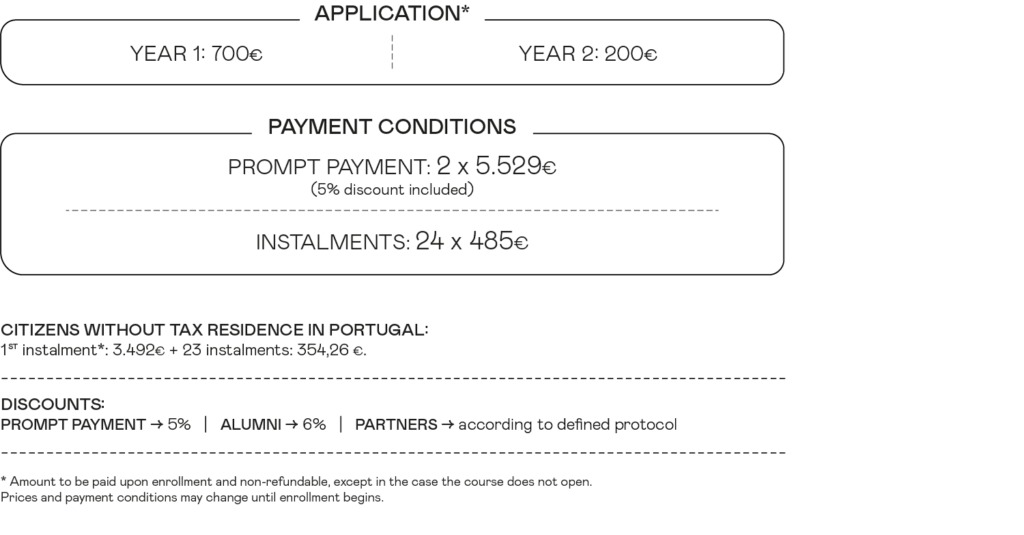
Several banks offer financing programmes to support training and education: Caixa Geral de Depósitos, Santander, Banco CTT, BPI, among others.
TERMS AND CONDITIONS
The opening of each course, class or timetable is subject to a minimum number of enrolments. Enrolment in a specific timetable is limited to the number of available places. Teaching is on-campus and project-based. The course programme includes sessions without a tutor, dedicated to the development of independent exercises and project work. Independent and project-based work is essential to students’ learning progress. Tutors may require students to complete assignments outside scheduled class hours.
Occasionally, classes may be scheduled outside the regular timetable, for example to accommodate projects that require greater flexibility, specific equipment needs, real-world exercises developed with partners, or any other reason that supports the effective delivery of the programme.
Specific technical classes and/or workshops may take place on Saturdays.
The duration of each class may vary depending on whether it is theoretical or practical in nature.
Classes may be divided into smaller groups to enhance learning and intensify the development of projects and course content.
The curriculum and teaching staff may be subject to change for pedagogical reasons or due to circumstances beyond the school’s control.
For further information, please contact us.
It focuses on fashion branding, marketing, communication and management, preparing students for strategic and creative roles in the fashion industry.
This course is designed for aspiring fashion professionals who want to develop a comprehensive understanding of fashion as both a creative and commercial industry. It is ideal for students who aim to combine brand strategy, marketing, and communication skills with practical expertise in fashion imagery, production, and event management.
Key skills include:
- Fashion brand management – including business strategy
- Fashion marketing and trend analysis – understanding consumers, digital marketing, and influencer strategies
- Creative communication and visual storytelling – producing fashion imagery, art direction, and digital content
- Personal branding and professional development – self-promotion, goal setting, and portfolio creation
Yes. The course is designed for beginners and students looking to transition into fashion management and communication.
As an international Fashion Management and Communication programme, English is used across all classes; projects and professional activities are set to prepare students for global experience, international collaboration and portfolio presentation for the worldwide industry.
Upon successful completion of the second year, students are awarded a BTEC Higher National Diploma, Level 5, carrying a total of 240 CATS credits*.
ETIC has been a Pearson BTEC Accredited Centre (Business and Technology Education Council) since 2016. The programmes have a duration of two years and are internationally recognised, enabling direct entry into the labour market as well as progression to further studies.
The programmes are assigned a qualification level by Ofqual (Office of Qualifications and Examinations Regulation) under the Regulated Qualifications Framework (RQF), which forms part of the UK qualifications system.
*CATS: Credit Accumulation and Transfer Scheme.