OVERVIEW
Content production — fiction, documentary and advertising — requires interdisciplinary skills. The Film & Television course projects integrate the competencies expected of audiovisual professionals, reflecting current industry standards.
The rapid growth of content production for streaming platforms has significantly increased the demand for professionals in the audiovisual sector. The ability of storytelling -and to combine image and sound- is developed through learning in key areas such as production, directing, screenwriting, lighting, sound, casting, actor direction, post-production and exhibition.
Throughout the Film & Television international certification course, students participate in festivals, workshops and conferences with industry specialists. They benefit from direct contact with professionals and develop innovative strategies to shape and strengthen their professional profile.
Final projects participate in national and international film and video competitions and festivals, where they are eligible for awards.
LEARNING METHODOLOGY
The School’s teaching is based on a project-based learning (PBL) approach, delivered in small classes of up to 18 students, ensuring close student-teacher interaction. Students learn by seeking solutions to real-world challenges, often working in teams, fostering their creative, critical, and personal development.
TEACHERS
The teaching staff is composed of active industry professionals, and students are encouraged to participate regularly in workshops, conferences, and study visits to enhance their knowledge and gain exposure to real-world professional environments.
PROGRAMME
This unit introduces the historical, social, psychological, commercial, and cultural context of the creative fields. It explores creativity as a driver of economic and cultural value, covering different genres and platforms of audiovisual production and distribution. The unit places visual and performing arts within current national and international creative industries.
This unit introduces cinematography and develops the technical and creative skills needed to operate a camera. Students explore different types of cameras and lighting equipment, learn how light works, and understand the roles and responsibilities of the camera crew.
This unit focuses on the techniques of directing and producing audio content for moving images. Students learn how to apply audio technologies to produce sound narratives for digital film and television projects.
This unit explores key moments in the history of editing while developing practical skills in image and sound. Students work with digitisation, synchronisation, and post-production workflows, finishing projects for cinema, television, and digital platforms.
The objective of this unit is to identify and practice the fundamental techniques and processes of filmmaking: writing, directing, acting direction, production, camera, lighting, sound, and editing. Students develop practical and creative skills to communicate film ideas through image and sound.
This project-based unit explores experimental approaches to moving images and sound. Using recording technologies in controlled environments, students create films that go beyond traditional narrative structures, challenging conventional cinematic language.
This unit challenges students to create television-style content based on interviews with professionals from the film or television industry, connecting personal testimony with professional and cultural contexts.
This unit develops skills in writing, planning, recording, and producing multicamera television programmes. Through team-based challenges, students work with broadcast-quality standards and professional production workflows.
This laboratory seeks to unify connections within the community. It is a meeting point and an exchange space dedicated to creativity, where interdisciplinary practices are explored both inside and outside the school environment. Communication is central to this process. The lab aims to identify and mobilize trends, experiment with new ways of thinking and conceptualizing, and facilitate synergies among students – a true learning tool.
Our courses share content and present challenges with an international perspective. We prepare and support our students with best practices in mind, regardless of geography or nationality. For this reason, knowing English is a fundamental tool for breaking down barriers: gaining access to more references, discovering more professional contexts, and developing a portfolio aligned with the best work being produced, without borders.
This unit provides the skills necessary to ensures connection with concrete moments of professional activity, in which students develop professional-level material and interact with professional teams, building bridges of contact with professionals from the national and international areas.
This unit emphasizes critical analysis and the understanding of theoretical frameworks within film creation, as well as their connection to television practice.
This unit focuses on producing documentaries with broadcast quality, developing the investigative skills necessary for work in the production and direction of documentary content, including cinematic, television and interactive formats.
This unit focuses on writing for the development of plots, characters, and dialogue, with particular emphasis on the practice and understanding of narrative structures. Scriptwriting processes are explored, and students develop the skills required to produce screenplays that meet professional quality standards for television and film fiction production.
This unit introduces the essential tools for creating and managing motion graphics processes and visual effects associated with graphic techniques. Students work with professional audiovisual post-production equipment, with a specific focus on the development of title sequences for films and television series.
This unit explores fiction filmmaking through the development of short films, adopting a professional approach to production, post-production, and presentation. Students gain an understanding of the key processes and stages involved in the conception, development, and production of a fiction film.
This project-based unit enables students to develop individual skills within a collaborative framework to complete a project in the field of film and television. Emphasis is placed on teamwork, with clearly defined and coordinated roles, encouraging collaboration with external participants and the integration of complementary projects within the school environment.
The objective is to prepare students for the project-driven dynamics of the creative industries, encourage teamwork, promote interdisciplinarity, foster a sense of responsibility and goal achievement, and also develop personal presentation and self-promotion skills. In this way, the school environment is brought closer to the reality of the professional world and its demands.
CERTIFICATION
At the end of the second year, students receive the Pearson BTEC Level 5 Professional Certification (240 CATS*).
Certification follows the British education system; ETIC is not a higher education institution.
*CATS: Credit Accreditation Transfer System
TEACHING STAFF
PEDRO SENNA NUNES
Coordinator
PEDRO SENNA NUNES
He is a film director, producer, cultural programmer, professor, and researcher at GECAPA, specialising in image and sound. He studied Film, Writing, Photography, Video, and Theatre at national and European institutions. His creative practice includes the direction of experimental, commercial, fiction, and documentary films.
He is co-artistic director of Vo’Arte and co-programmer of the InShadow, InArt, and InMotion festivals, as well as the Viana International Film Encounters, and regularly collaborates with the Filmes do Homem Festival. He is also a co-founder of the Companhia de Teatro Meridional and inclusive cultural projects such as CiM and Geração Soma.
He previously served as Creative Director at ETIC and as consultant and coordinator for several international cultural and educational projects. He is currently a PhD candidate in Performing Arts and Moving Image at the University of Lisbon. His work in experimental and documentary photo-cinematography has received multiple awards.
ALEXANDRE AFONSO
Tutor
ALEXANDRE AFONSO
With a background in Directing, he has been part of the technical department at ETIC since 2009. He has extensive professional experience in video and photography production for a wide range of national and international events, including Rock in Rio, Festival Territórios, and ZEMOS98. He also collaborates in the performing arts sector, contributing to concerts and theatre productions.
DORA NOBRE
Programme Manager
DORA NOBRE
Holds a degree in Communication Sciences with a specialization in Public Relations, and additional training in Political Marketing and Performing Arts Management/Production. She began working in production for various cultural projects over 20 years ago. Since 2004, she has held roles at ETIC involving Coordination, Pedagogical Management, and training in the areas of Film and TV, Journalism, Fashion, and Event Production. She also coordinates extracurricular projects within strategic partnerships for the school, such as Rock In Rio, MIL, and others.
NÉLIA CRUZ
Teacher
NÉLIA CRUZ
Screenwriter and Professor
Nélia Cruz holds a PhD in Communication and Culture from the School of Arts and Humanities of the University of Lisbon, with a thesis entitled ‘Screenwriting as a cultural practice: the Screenwriter’s gaze’,, and is also a Specialist Professor in Audiovisual and Multimedia. She is a producer, director, screenwriter, university lecturer, and researcher; her areas of interest include screenwriting studies, audiovisual narratives, memory studies, and media literacy. She has also spoken at several conferences on these topics.
CÉSAR PEDRO
Teacher
CÉSAR PEDRO
Film Director and Post-Producer
His debut was marked by the co-direction of the short film, “Conferência” (Conference), which won the Young Creators award. A graduate of ESMAE, his initial work focused on documentary, experimental cinema, music, and theatre. He participated in the European Capitals of Culture in Vilnius and Guimarães with documentaries of his own making and was a finalist in the Inov-Art programme in Mozambique, where he produced and directed his first feature film, “Casa Velha”. He worked as a technical coordinator for cinema venues, festivals, and seminars, notably at the Grupo Musical de Miragaia, Doc’s Kingdom, and Doclisboa. In addition, he was a founder and programmer of the Aurélio da Paz dos Reis Film Club and Confederação. Currently, he teaches in various Film and Multimedia departments across secondary and higher education. The short film “Silêncios” (Silences) served as his Master’s thesis at the Faculty of Fine Arts of the University of Lisbon, and he is presently undertaking his PhD in Performing Arts and Moving Image.
DAVID BONNEVILLE
Teacher
DAVID BONNEVILLE
Film Director
David has written and directed “The Last Bath”, selected for festivals such as Tokyo, São Paulo and Gothenburg. It won the Sophia Awards for Best Picture, Best Original Screenplay and Best Art Direction.
His shorts “Heiko”, “L’Arc-en-Ciel” and “Gypsy” have also garnered praise from critics and audiences alike. His work has been showcased in retrospectives across South Korea, Poland, Spain, the UK, and Portugal.
He has been lecturing on filmmaking, acting and screenwriting.
INÊS SALES
Teacher
INÊS SALES
Producer
Inês Sales is a television and events producer with over 20 years of experience. She graduated from the Lisbon Theatre and Film School and completed an Erasmus program in Rome. She further specialized in production through training at ETIC and Fórum Dança. She has worked with leading television and film production companies in Portugal, including Plural, SP, Valentim de Carvalho, Warner Bros. Portugal and UKBAR. Since 2018, she has collaborated with international event agencies, was involved in the production of the Paris 2024 Olympic Games, and in 2026 joins the Fondazione Milano Cortina team for the Winter Olympic Games, in Italy.
BÁRBARA VALENTINA
Teacher
BÁRBARA VALENTINA
Film Producer
With a career in film production spanning more than 20 years, she has worked as an executive producer, line producer and project development coordinator, producing and developing several documentaries and fiction films for various production companies such as David & Golias, Terratreme, and Leopardo Filmes. She has also worked at several film festivals, including the Lisbon & Estoril Film Festival, and as post-production coordinator at Walla Collective. She teaches at ETIC, on the Film and Television course, since 2015.
MÓNICA LIMA
Teacher
MÓNICA LIMA
Film Director
Mónica Lima is a film director and screenwriter, trained at the Berlin Academy of Film and Television (DFFB), where she began her career in cinema before moving to Lisbon. She is the author of several short films that have been screened and awarded at dozens of international festivals and are available on VoD platforms such as Filmin. She has also been working as an assistant director and as a tutor in various fields of cinema, gaining multidisciplinary experience. She has served as a jury member at film festivals, including the International Film Festival Rotterdam. Her first feature film is currently in post-production.
MAFALDA ROMA
Teacher
MAFALDA ROMA
Sound Director
Cinema, Sound branch from ESTC. Master’s degree in Art Education from FBAUL. Specialist in Sound for Audiovisual and Multimedia. PhD candidate in Media Art and Communication (Lusófona University). University professor and certified trainer in Cinema – Sound.
Sound Director for Cinema and Audiovisuals, since 1993 she has worked regularly in production sound mixing in various projects. She has worked in Audio Post-production since 1998, editing and mixing, functions she performed most intensively between 2001 and 2014.
In parallel, since 2001, she has developed work in education, in the field of sound for cinema and audiovisuals, gradually intensifying her pedagogical activity.
ANTÓNIO PASCOALINHO
Teacher
ANTÓNIO PASCOALINHO
Film Critic
After graduating in film by the Superior School of Theatre and Cinema, worked as an editor and video producer at Radiotelevisão Comercial for 16 years. Next he was responsible for choosing, buying and programming all the movies shown by RTP1 for 4 years.
Film director of the short film “Reborn”, selected for the competition of the Motel X festival. During my long connections with the film world, he worked as a film critic for several newspapers and magazines and was a guest member in different juris for important film festivals in Portugal, such as Fantasporto, Festróia, FICA, Ovarvídeo and FEST.
He taught several units connected with film history and aesthetics in schools such as EPI, IPA and ETIC.
PEDRO CABELEIRA
Teacher
PEDRO CABELEIRA
Film Director and Scripwriter
Pedro Cabeleira was born in 1992, Entroncamento – Portugal.
After graduating in Directing from the Lisbon Theatre and Film School, he started shooting his first feature film with no budget and working with young actors and a young crew he met during film school. Filmed over a year and with a post-production period of three years, “Damned Summer” premiered in 2017 in Locarno (Special Mention from the Jury). The film was then selected for several international film festivals, including Mar del Plata, Torino, Tiblisi, Vilnius and Cannes 2018 (in the parallel section ACID TRIP).
After that he directed By Flávio”, a short-film that premiered at Berlinale Shorts 2022 and won the Sophia Award (Portuguese Academy of Cinema) for Best Short Film – Live Action.
He premiered “Entroncamento”, his second long feature, in this year’s edition of Cannes Film Festival at the parallel section – ACID Cannes 2025.
PAULO SOARES
PEDRO SOUSA
RUI MEDEIROS
JOÃO CUNHA
RITA JORGE
CAREER PATHS
- Film, video, television, and advertising production companies;
- Television stations, thematic channels, and in-house TV networks;
- Image and sound post-production departments in companies and institutions;
- Camera operators, camera and sound assistants;
- Production assistants, directors’ assistants, and floor managers;
- Post-producers and video editors;
- Script annotators and assistants in writing and reviewing screenplays;
- Creation and management of one’s own business in various areas of film and audiovisual production.
ERASMUS+ & INTERNSHIPS
At the end of the programme, and subject to academic performance, students may apply for:
- an international internship through the Erasmus+ Programme;
- a national/international internship or job opportunities for industry placements with partner companies;
Applications are submitted through the Professional Integration Department (estagios@etic.pt).
ETIC provides a digital platform to communicate job offers and employment opportunities from partner companies.
FACILITIES
ETIC is a school equipped with state-of-the-art technology, tailored to meet the specific demands of each area of study and industry:
- Video and Multimedia Studio with cyclorama and virtual set and motion capture system;
- Video control room equipped with broadcast cameras;
- Audio recording rooms and sound studios;
- Cameras: Sony NEX50, Panasonic DVX-200 4K, Blackmagic cinema camera 2.5K, Panasonic GH4 and GH5. Various lenses and image stabilizers such as gimbals and sliders;
- Audio recorders and microphones;
- Studio and outdoor lighting kits;
- Computer rooms equipped with individual workstations and headphones;
- Software used: Adobe Creative Cloud Suite, DaVinci Resolve, Microsoft Office 365
APPLICATION
The programme is delivered in English. Recommended english entry level: B1*
Requirements
– Submit a motivation letter, outlining reasons for applying and professional goals;
– Submit portfolio or showreel;
– Attend an interview.
How do I start my application?
– Fill in the form by clicking the APPLY button.
– You will receive an email with dates options for your interview.
*According to CEFR Levels. If you would like to take a free online test , please click English Test.
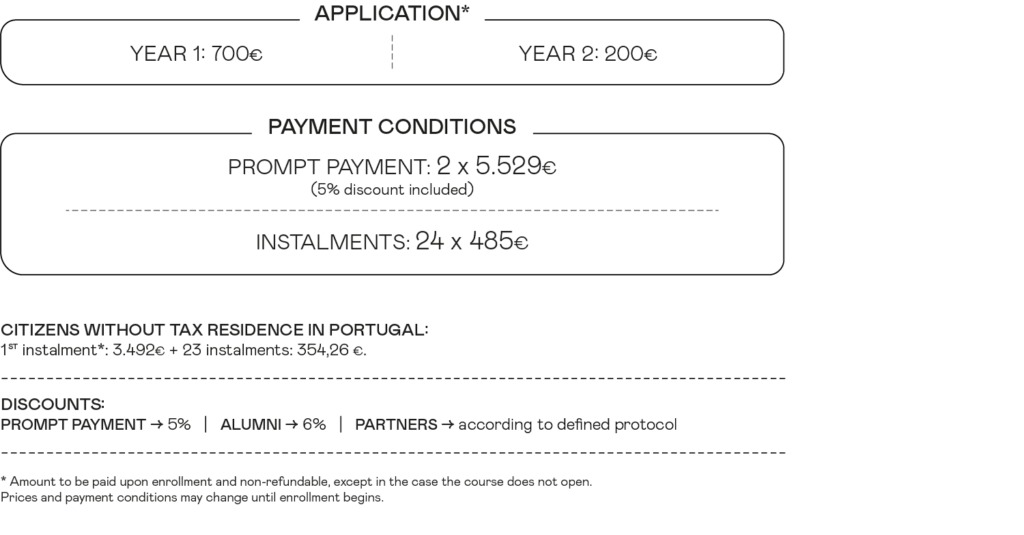
TUITION FEES
Several banks offer financing programmes to support training and education: Caixa Geral de Depósitos, Santander, Banco CTT, BPI, among others.
TERMS AND CONDITIONS
The opening of each course, class or timetable is subject to a minimum number of enrolments. Enrolment in a specific timetable is limited to the number of available places. Teaching is on-campus and project-based. The course programme includes sessions without a tutor, dedicated to the development of independent exercises and project work. Independent and project-based work is essential to students’ learning progress. Tutors may require students to complete assignments outside scheduled class hours.
Occasionally, classes may be scheduled outside the regular timetable, for example to accommodate projects that require greater flexibility, specific equipment needs, real-world exercises developed with partners, or any other reason that supports the effective delivery of the programme.
Specific technical classes and/or workshops may take place on Saturdays.
The duration of each class may vary depending on whether it is theoretical or practical in nature.
Classes may be divided into smaller groups to enhance learning and intensify the development of projects and course content.
The curriculum and teaching staff may be subject to change for pedagogical reasons or due to circumstances beyond the school’s control.
For further information, please contact us.
The Film and Television International Certification is a two year programme focused on professional audiovisual production. It covers fiction, documentary, television and advertising, combining storytelling, directing, production, camera, sound and post production within a project based learning approach.
Students develop technical, creative and critical skills across the full audiovisual pipeline. These include screenwriting, directing, cinematography, sound recording, editing, post production, documentary production and collaborative project development for film and television.
The programme starts with foundational concepts in the first year and progressively advances toward professional level projects. It is suitable for students starting in audiovisual creation as well as those seeking structured professional training.
Students can work in film, television and advertising production companies, television channels, post production studios and audiovisual departments. Career paths include director, producer, camera operator, editor, production assistant, script assistant and independent audiovisual creator.
As an international Film & Television programme, English is used across all classes; projects and professional activities are set to prepare students for global experience, international collaboration and portfolio presentation for the worldwide industry.
Upon successful completion of the second year, students are awarded a BTEC Higher National Diploma, Level 5, carrying a total of 240 CATS credits*.
ETIC has been a Pearson BTEC Accredited Centre (Business and Technology Education Council) since 2016. The programmes have a duration of two years and are internationally recognised, enabling direct entry into the labour market as well as progression to further studies.
The programmes are assigned a qualification level by Ofqual (Office of Qualifications and Examinations Regulation) under the Regulated Qualifications Framework (RQF), which forms part of the UK qualifications system.
*CATS: Credit Accumulation and Transfer Scheme.