OVERVIEW
Digital 2D Animation – Concept, Development, and Production
Since its origins as a visual experiment, animation has evolved into a powerful medium for creating entertainment, storytelling and education engaging audiences of all ages. The growing diversity of applications has increased the demand not only for technically skilled animation professionals, but also for creative animation artists with a critical mindset, strong cultural awareness and the ability to produce original, purposeful work.
The British International Certification Animation course provides specialised training in animated audiovisual production, covering all stages of concept development, design and production. It aims to prepare students to work independently as authors while also equipping them to integrate into large-scale commercial animation productions.
LEARNING METHODOLOGY
The School’s teaching is based on a project-based learning (PBL) approach, delivered in small classes of up to 18 students, ensuring close student-teacher interaction. Students learn by seeking solutions to real-world challenges, often working in teams, fostering their creative, critical, and personal development.
TEACHERS
The teaching staff is composed of active industry professionals, and students are encouraged to participate regularly in workshops, conferences, and study visits to enhance their knowledge and gain exposure to real-world professional environments.
programme
This unit introduces the fundamental principles of animation, including timing, movement and fluidity, through a combination of theoretical instruction and practical exercises. It also provides an overview of the history and evolution of animation as an art form. Students learn to use TVPaint, the industry-standard software for professional animation.
This core unit explores the fundamentals of storytelling and visual narrative for animation, covering key aspects of cinematography, character design and narrative structure. Students develop original stories, characters, environments and storyboards, while strengthening their visual culture and critical thinking skills.
Essential for any author, this module explores screenwriting for animation, focusing on creative writing techniques aligned with industry standards.
This unit introduces the fundamentals of 3D modelling and its application as a support tool for 2D production. Students practise modelling and learn the language and core concepts of 3D animation, acquiring the skills required to participate in hybrid 2D/3D productions.
This first project unit provides hands-on experience in small-scale animation production. Students are given a creative brief and apply the knowledge acquired throughout the semester to produce short films in groups. They assign production roles, follow a structured schedule and explore the different stages of the animation pipeline, contextualised within its historical and technological development, as well as the various specialised professional roles involved.
This Laboratory aims to unify connections within the community. It serves as a meeting point and exchange of experiences, a space dedicated to creativity where interdisciplinary practices are explored and developed, both inside and outside the school environment. Communication is the main key to this process. The lab seeks to identify and mobilize trends, experiment with new ways of thinking and conceptualizing, and facilitate synergies among students. This is a laboratory presented as a learning tool.
Our courses share content and present challenges with an international perspective. We prepare and support our students with best practices in mind, regardless of geography or nationality. For this reason, knowing English is a fundamental tool for breaking down barriers: gaining access to more references, discovering more professional contexts, and developing a portfolio aligned with the best work being produced, without borders
This unit introduces compositing in After Effects and the fundamentals of sound design. Students explore the key stages of finalising an animated project, integrating visual and audio elements to produce a polished work ready for distribution.
The unit provides an in-depth study and practical exploration of advanced 2D animation techniques, including character acting, lip sync, interaction and special effects.
It focus on the application of creative tools such as moodboards and styleframes, alongside the analysis of animation works and visual styles. Students develop original concepts, build reference libraries and work on character design, colourscripts and story beats. The module culminates in the creation and presentation of an original pitch and proof of concept.
It is a large-scale collaborative project in which students apply the knowledge acquired throughout the course to produce an animated short film. It simulates a professional production environment, promoting teamwork and the management of creative processes within a structured schedule.
IT aims to prepare students for their transition into the job market, with a focus on portfolio development and navigating the animation industry.
The objective is to prepare students for the project-driven dynamics of the creative industries, encourage teamwork, promote interdisciplinarity, foster a sense of responsibility and goal achievement, and also develop personal presentation and self-promotion skills. In this way, the school environment is brought closer to the reality of the professional world and its demands.
CERTIFICATION
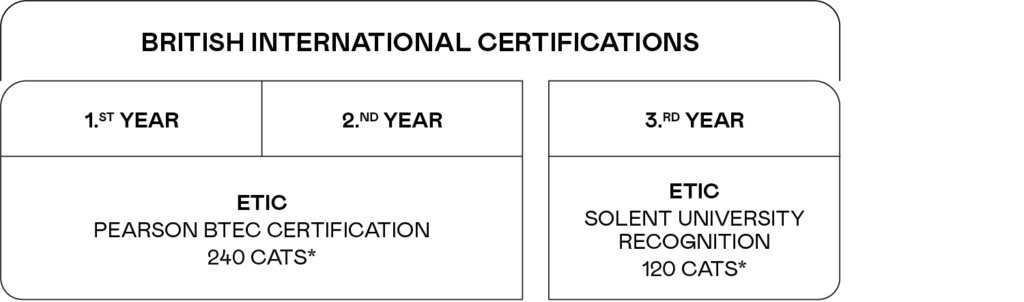
At the end of the second year, students receive the Pearson BTEC Level 5 Professional Certification (240 CATS*).
Certification follows the British education system; ETIC is not a higher education institution.
*CATS: Credit Accreditation Transfer System
TEACHING STAFF
Ana Moniz
Coordinator
Ana Moniz
Ana Moniz works as a freelancer on animated series and commercials, having collaborated on shows like Legend of Vox machina, Pantheon and Mighty Nein, with companies such as HBO, Prime, and AMC.
Having completed her Masters at Gobelins, in Paris, her thesis film SUNDOWN won several awards at international festivals. Since 2023, she has returned as a guest lecturer. Ana specializes in storytelling and visual narrative, areas in which she has developed lectures and intensive courses.
Ricardo Toureiro
Sofia Mateus
Gonçalo Dias
Teacher
Gonçalo Dias
Gonçalo Dias is a Lisbon-based Matte painter, Background artist, Visual development artist and Director, currently developing his first animated short film. He studied Fine Arts in Lisbon, earning his BA in Drawing and Digital Art, and later pursued Visual Development training at IDEA Academy in Rome.
Afterwards, he lived in London, working with DNEG Animation and Jellyfish Pictures on productions including Nimona (Oscar-nominated, 2024), Garfield, Dogman and Wolf King .
Luís Vital
Teacher
Luís Vital
Animator and Director.
Luís Vital is a Portuguese 2D animator with experience in short films, commercial projects and independent productions. He is known for his work on “Ice Merchants” by João Gonzalez and “Menina dos Olhos Ocupados” by André Carrilho, two projects of significant artistic recognition in the Portuguese animation scene. His work spans a range of techniques, from traditional 2D to cutout animation.
Francisco Valle
Teacher
Francisco Valle
Diana David
Teacher
Diana David
Diana David is a Digital Artist with expertise across the full production pipeline of 2D and 3D animation. She has a particular interest in Animation and Characters, and is also proficient in areas such as 3D modelling, rigging, illustration, storyboarding, design, and related practices.
Over the past 15 years, she has worked professionally in Portugal, England, and Spain as a 2D/3D Animator, Storyboard Artist, and Character Designer on advertising campaigns, animated series, short films, the first Portuguese 3D animated feature film, as well as VR and AR animations for museums, exhibitions, and 360° immersive projections.
In addition, she has experience as a Content Artist and GUI Designer for mobile games (Android and iOS) and console games (Xbox and Wii U), and has worked as a lecturer and professor at ETIC, World Academy, IADE, and the Polytechnic of Leiria (IPLeiria).
She holds a PhD in Animation in Virtual Reality, awarded with Distinction and Honours, from the Faculty of Fine Arts, University of Lisbon (FBAUL); a Master’s degree in 3D Computer Animation from Bournemouth University; and a BA (Hons) in Multimedia Art from FBAUL.
She is also the creator and driving force behind TugaNetwork.
CAREER PATHS
- Animation Film Director
- 2D Animator
- Storyboard Artist
- Art Director
- Character Designer
- Visual Development Artist
- Layout Artist
- Producer
- 3D Artist
- Project Coordinator
- Compositing Artist
ERASMUS+ & INTERNSHIPS
At the end of the programme, and subject to academic performance, students may apply for:
- an international internship through the Erasmus+ Programme;
- a national/international internship or job opportunities for industry placements with partner companies;
Applications are submitted through the Professional Integration Department (estagios@etic.pt).
ETIC provides a digital platform to communicate job offers and employment opportunities from partner companies.
FACILITIES
ETIC is a school equipped with state-of-the-art technology, tailored to meet the specific demands of each area of study and industry:
Digital Drawing tablets;
Adobe Creative Suite;
TVPaint;
Blender – 3D software or Autodesk Maya.
APPLICATION
The programme is delivered in English. Recommended english entry level: B1*
Requirements
– Submit a motivation letter, outlining reasons for applying and professional goals;
– Submit portfolio or showreel;
– Attend an interview.
How do I start my application?
– Fill in the form by clicking the APPLY button.
– You will receive an email with dates options for your interview.
*According to CEFR Levels . If you would like to take a free online test , please click English Test
TUITION FEES
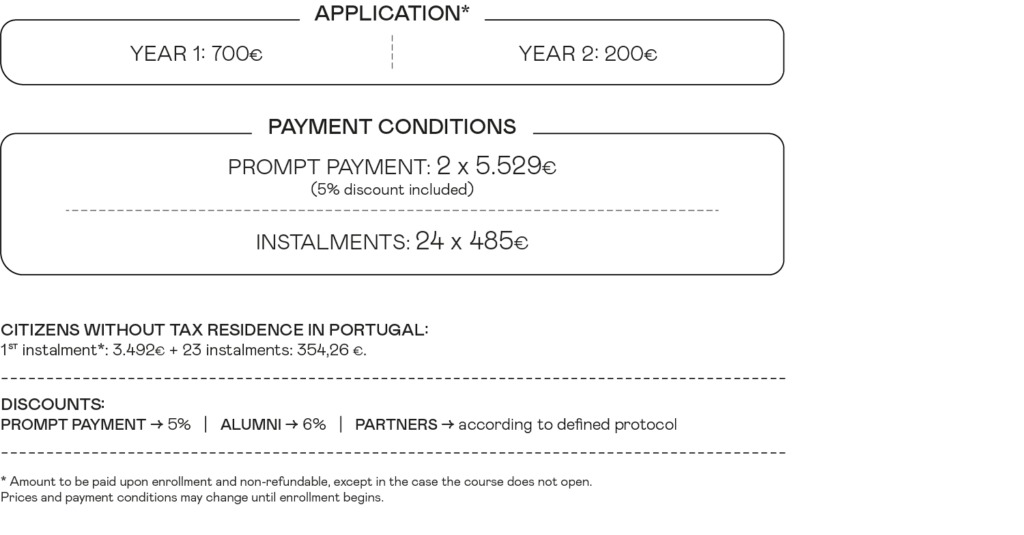
Several banks offer financing programmes to support training and education: Caixa Geral de Depósitos, Santander, Banco CTT, BPI, among others.
Terms and Conditions
The opening of each course, class or timetable is subject to a minimum number of enrolments. Enrolment in a specific timetable is limited to the number of available places. Teaching is on-campus and project-based. The course programme includes sessions without a tutor, dedicated to the development of independent exercises and project work. Independent and project-based work is essential to students’ learning progress. Tutors may require students to complete assignments outside scheduled class hours.
Occasionally, classes may be scheduled outside the regular timetable, for example to accommodate projects that require greater flexibility, specific equipment needs, real-world exercises developed with partners, or any other reason that supports the effective delivery of the programme.
Specific technical classes and/or workshops may take place on Saturdays.
The duration of each class may vary depending on whether it is theoretical or practical in nature.
Classes may be divided into smaller groups to enhance learning and intensify the development of projects and course content.
The curriculum and teaching staff may be subject to change for pedagogical reasons or due to circumstances beyond the school’s control.
For further information, please contact us.
The Animation course focuses on professional 2D animation, covering storytelling, animation principles, production pipelines and portfolio development.
This course is designed for aspiring 2D animators and visual storytellers who want to develop strong creative, technical, and professional skills in animation production. It is particularly suited to students who are interested in animated storytelling, character-driven narratives, and collaborative studio-based workflows.
Basic drawing skills are recommended, but the course starts from foundational principles and develops progressively. The level of complexity increases gradually, ensuring that students develop skills, confidence and autonomy while being supported by close mentoring and guided project development.
The Animation course at ETIC develops 2D animation, visual storytelling, post-production, collaboration and professional skills, preparing students for careers in the animation and creative media industries.
Key skills developed include:
- 2D animation skills
- Visual storytelling and narrative development, covering story structure, cinematography, character design and storyboarding
- Screenwriting for animation
- Post-production skills
Students work with industry standard tools such as TvPaint, Adobe After Effects, Blender and Autodesk Maya.
Basic artistic skills are recommended. The programme is structured to help students study animation progressively, from the fundamental principles of animation to advanced professional practice.
As an international programme, English is used across all classes; projects and professional activities are set to prepare students for global experience, international collaboration and portfolio presentation within the industry.
Upon successful completion of the second year, students are awarded a BTEC Higher National Diploma, Level 5, carrying a total of 240 CATS credits*.
ETIC has been a Pearson BTEC Accredited Centre (Business and Technology Education Council) since 2016. The programmes have a duration of two years and are internationally recognised, enabling direct entry into the labour market as well as progression to further studies.
The programmes are assigned a qualification level by Ofqual (Office of Qualifications and Examinations Regulation) under the Regulated Qualifications Framework (RQF), which forms part of the UK qualifications system.
*CATS: Credit Accumulation and Transfer Scheme.
After finishing the course, students can work as animators, storyboard artists, visual development artists, art directors or pursue independent and studio based animation careers.