PORTFOLIO
OVERVIEW
The video game industry generates billions of dollars and employs thousands of professionals worldwide. The Art and Videogames British Certification at ETIC offers pathways to an international career. Developing a strong portfolio is essential for entry into the video games industry at both national and international levels. Throughout the course, students will create and present their own projects within the artistic fields in Video Games and Digital Animation.
The course promotes student participation in game jams, workshops and industry events, which allows to expand technical knowledge and establish professional connections with industry specialists. Students acquire skills that enable them to work remotely and collaborate with organisations and clients worldwide.
LEARNING METHODOLOGY
The School’s teaching is based on a project-based learning (PBL) approach, delivered in small classes of up to 18 students, ensuring close student-teacher interaction. Students learn by seeking solutions to real-world challenges, often working in teams, fostering their creative, critical, and personal development.
TEACHERS
The teaching staff is composed of active industry professionals, and students are encouraged to participate regularly in workshops, conferences, and study visits to enhance their knowledge and gain exposure to real-world professional environments.
PROGRAMME
Students explore key historical precedents and the evolution of the videogaming industry, analysing iconic titles that shape today’s games.
The creative industries are increasingly interconnected. Understanding the historical, cultural and technological context helps students make sense of today’s global videogame ecosystem.
Videogames go far beyond what players see at first glance. There is much more behind the concepts and mechanics that bring a game to life, and in this unit we learn to look beyond the basics.
As one of the pillars of the course, animation is essential to bringing a video game to life. From the principles of animation to concepts of movement, this is the unit that helps you better understand how to apply and improve these techniques.
This Laboratory seeks to unify connections among the elements of the community. It is a meeting point and a place for exchanging experiences, a space dedicated to creativity where interdisciplinary practices are explored and developed, both inside and outside the school environment. Communication is the key element in this process. The laboratory aims to identify and mobilize trends, experiment with new ways of thinking and conceptualizing, and facilitate synergies among students. It is a laboratory that presents itself as a learning tool.
An idea only finds expression when it is materialised, and the importance of conceptual art lies in its transition to paper or any medium that allows the idea to come to life.
The student will be able to develop and improve their skills in perspective, spatial awareness, and the creation of 3D models. They will have access to tools that allow them to create, build, and model virtually any type of idea.
It results in the creation of an individual project where the concepts learned throughout the first year are put to the test. With the teacher’s support, the student must develop their project and understand how it fits within the industry.
Our courses share content and present challenges with an international perspective. We prepare and support our students with best practices in mind, regardless of geography or nationality. For this reason, knowing English is a fundamental tool for breaking down barriers: gaining access to more references, discovering more professional contexts, and developing a portfolio aligned with the best work being produced, without borders
A game is made up of mechanics and concepts, but even without words, a game tells a story. Whether through settings, characters, or atmosphere, narrative is always present in a video game, and this is the unit that helps students understand how they can apply this art.
A video game is the sum of many parts, and no matter how developed it may be in various areas, its content must make sense to explore. Level Design is where the logic of environments and mechanics is deepened through real techniques and tools
The objective is to prepare students for the project-driven dynamics of the creative industries, encourage teamwork, promote interdisciplinarity, foster a sense of responsibility and goal achievement, and also develop personal presentation and self-promotion skills. In this way, the school environment is brought closer to the reality of the professional world and its demands.
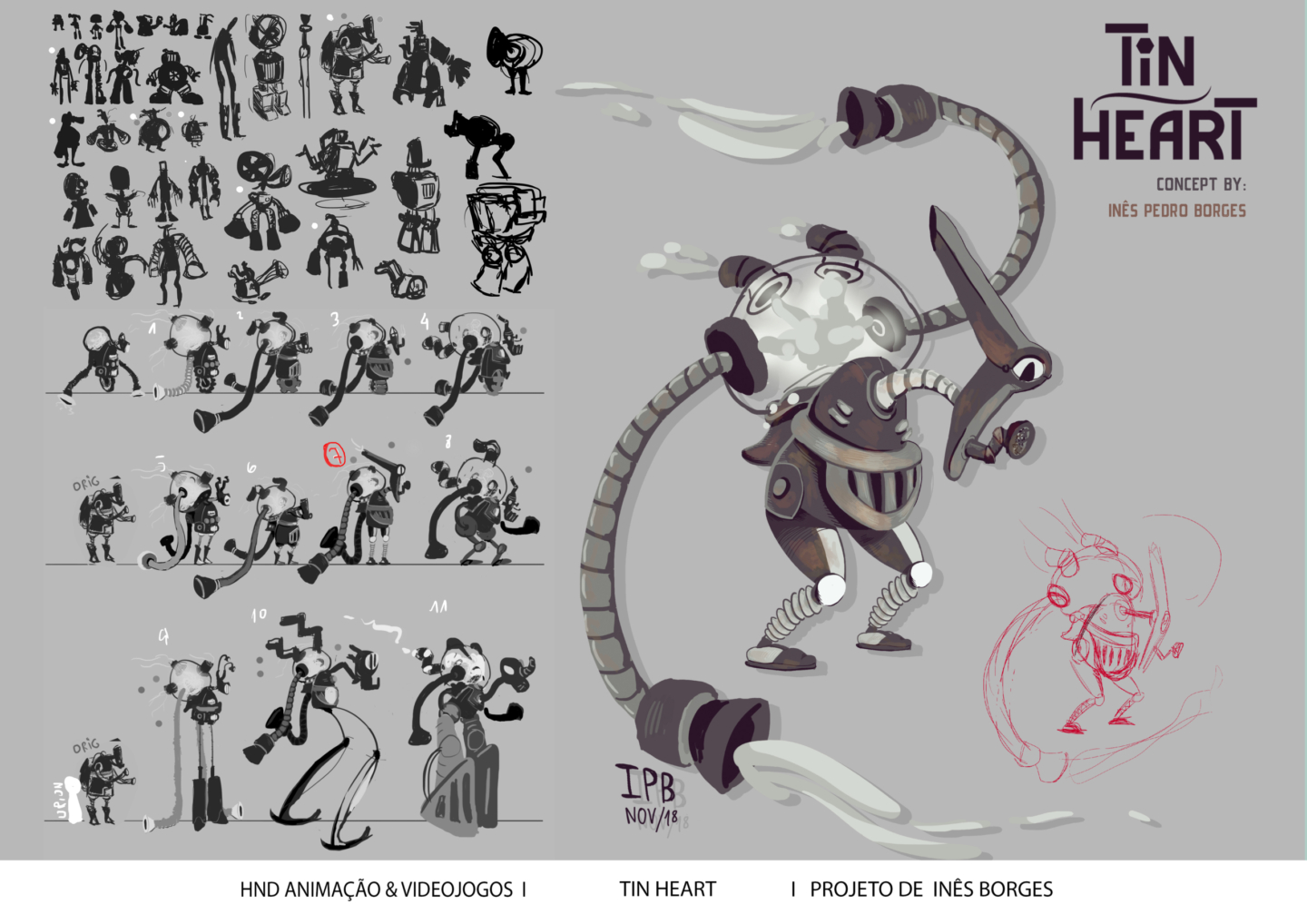
Putting an idea onto paper is only one part of what Concept Art is. There is an endless variety of techniques and approaches to learn that give depth and validity to this art, making a real difference in the final outcome.
Advanced 3D Modeling is the evolution of the techniques and concepts acquired in the first year. Here, students expand their knowledge, explore new techniques, and improve their ability to create and model on 3D platforms.
There are various types of animation and multiple ways to achieve the same goal; however, there is a process to follow to make the animation a better result, far beyond just a sequence of frames. This is where students learn these steps.
The industry requires skilled and creative professionals — but also individuals with good soft skills. This module introduces professional tools, work ethics and industry expectations.
This corresponds to the final project. Together with other classmates, it will be necessary to combine efforts and the knowledge gained throughout the year to create a playable final project incorporating various concepts and skill
CERTIFICATION
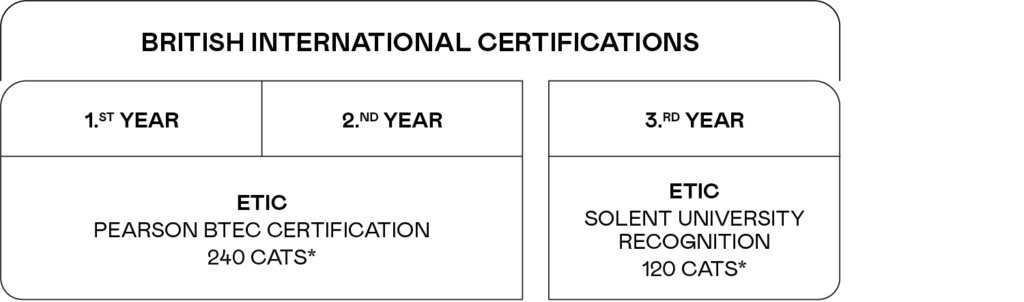
At the end of the second year, students receive the Pearson BTEC Level 5 Professional Certification (240 CATS*).
Certification follows the British education system; ETIC is not a higher education institution.
*CATS: Credit Accreditation Transfer System
TEACHING STAFF
DANIEL SILVESTRE
RICARDO TOUREIRO
Tutor & Course Coordinator 3rd Year
RICARDO TOUREIRO
Designer, Artist and Programmer. Specialised in 3D visualisation and virtual spaces. Holds a degree in Industrial Design from IADE.
His work in game development has a strong experimental component, taking on the roles of designer, artist, and programmer.
Saber +
SOFIA MATEUS
IVAN BARROSO
JOÃO CANELO
TIAGO LOBO PIMENTEL
ALEXANDRE BARBOSA
MIGUEL MARTINHO
RUI CIPRIANO
BEATRIZ AVELINO
CAREER PATHS
- 2D Animator
- 3D Animator
- Concept Artist
- Character Designer
- Illustrator
- 3D Artist
- Environment Artist
- Game Designer
ERASMUS+ & INTERNSHIPS
At the end of the programme, and subject to academic performance, students may apply for:
- an international internship through the Erasmus+ Programme;
- a national/international internship or job opportunities for industry placements with partner companies;
Applications are submitted through the Professional Integration Department (estagios@etic.pt).
ETIC provides a digital platform to communicate job offers and employment opportunities from partner companies.
FACILITIES
ETIC is a school equipped with state-of-the-art technology, tailored to meet the specific demands of each area of study and industry:
– PC workstations
– Adobe Photoshop, Illustrator, After Effects, InDesign
– Substance Painter, Designer
– Autodesk Maya
– Blender
– Unreal Engine
– Discord, Microsoft Office 365
– Video, Sound and Photography studios
APPLICATION
The programme is delivered in English. Recommended english entry level: B1*
Requirements
– Submit a motivation letter, outlining reasons for applying and professional goals;
– Submit portfolio or showreel;
– Attend an interview.
How do I start my application?
– Fill in the form by clicking the APPLY button.
– You will receive an email with dates options for your interview.
*According to CEFR Levels. If you would like to take a free online test , please click English Test
TUITION FEES
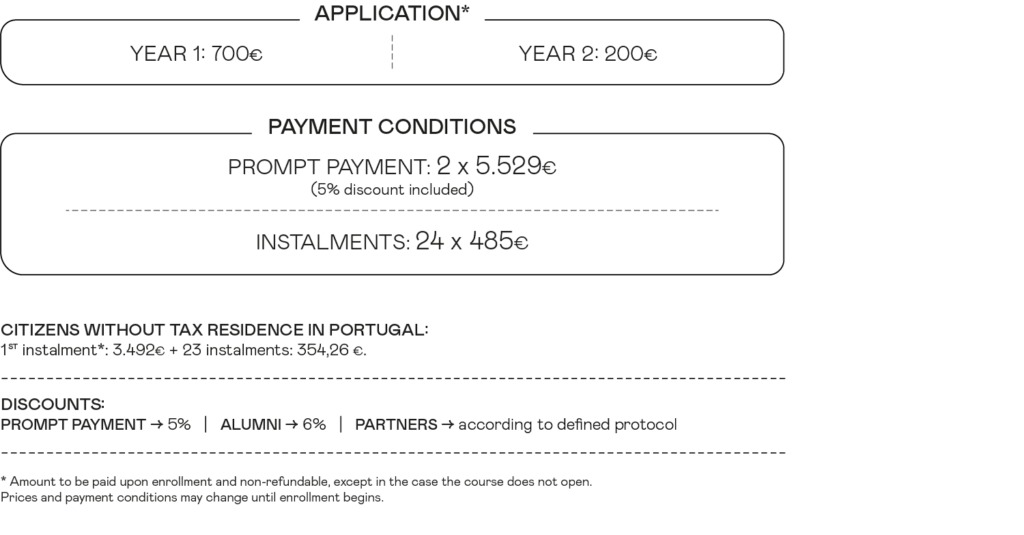
Several banks offer financing programmes to support training and education: Caixa Geral de Depósitos, Santander, Banco CTT, BPI, among others.
Terms and Conditions
The opening of each course, class or timetable is subject to a minimum number of enrolments. Enrolment in a specific timetable is limited to the number of available places. Teaching is on-campus and project-based. The course programme includes sessions without a tutor, dedicated to the development of independent exercises and project work. Independent and project-based work is essential to students’ learning progress. Tutors may require students to complete assignments outside scheduled class hours.
Occasionally, classes may be scheduled outside the regular timetable, for example to accommodate projects that require greater flexibility, specific equipment needs, real-world exercises developed with partners, or any other reason that supports the effective delivery of the programme.
Specific technical classes and/or workshops may take place on Saturdays.
The duration of each class may vary depending on whether it is theoretical or practical in nature.
Classes may be divided into smaller groups to enhance learning and intensify the development of projects and course content.
The curriculum and teaching staff may be subject to change for pedagogical reasons or due to circumstances beyond the school’s control.
For further information, please contact us.
The Art and Videogames International British Certification is a two-year professional programme focused on videogame art, animation and design. It combines creative development, technical training and portfolio building, preparing students for artistic roles in the international videogame industry.
This videogame art course is ideal for students who want to work in game art, animation or design and prefer a practical, project-based approach. It suits creative profiles interested in concept art, 3D modelling, animation and visual storytelling for games.
This is a Video Game Art and Animation course, not a programming-focused programme. While students learn how game engines work and collaborate in playable projects, the main emphasis is on artistic creation, animation, concept art and visual development for videogames.
Students develop skills in:
- Concept art and visual development
- 2D and 3D animation principles
- 3D modelling for games
- Storytelling and level design
- Industry workflows and professional practice
These skills support a strong artistic profile aligned with current industry demands.
As an international videogame art and animation programme, English is used across all classes; projects and professional activities are set to prepare students for global studios, international collaboration and portfolio presentation for the worldwide videogame industry.
Upon successful completion of the second year, students are awarded a BTEC Higher National Diploma, Level 5, carrying a total of 240 CATS credits*.
ETIC has been a Pearson BTEC Accredited Centre (Business and Technology Education Council) since 2016. The programmes have a duration of two years and are internationally recognised, enabling direct entry into the labour market as well as progression to further studies.
The programmes are assigned a qualification level by Ofqual (Office of Qualifications and Examinations Regulation) under the Regulated Qualifications Framework (RQF), which forms part of the UK qualifications system.
*CATS: Credit Accumulation and Transfer Scheme.