

Overview
A strong idea only becomes powerful when it is well told. What sets professionals apart is the ability to transform ideas into compelling narratives that create impact.
Today, brands, studios, game developers and digital platforms seek creative writers who can craft stories with purpose and emotional resonance. These professionals know how to shape narratives that engage audiences and achieve clear communication goals.
The Crossmedia Creative Writing course is a two-year multidisciplinary programme designed to give voice to your creativity and turn your passion for words into a successful professional future. It equips students with the creative, technical and conceptual skills required to write effectively across multiple platforms and media, preparing them for a successful career in contemporary storytelling.
PROGRAMME
An in-depth exploration of professional writing craft, mastering techniques and versatility exercises. Students refine their individual voice/style, leveraging powerful tools to create impactful and polished texts across various professional contexts.
Uncover the secrets of plots, character development, and textual rhythm. Learn universal storytelling techniques to engage any audience, in any format.
Focusing on audiovisual fiction, this unit covers writing for film, TV series, and web-series. Students will master industry-standard formats and story structures, learning screenwriting techniques from initial concept to a polished script.
Explore the evolution of advertising to the present day. This unit teaches how to craft persuasive messages that drive results and develop a distinct brand voice for traditional media: TV, print, outdoor, and radio. It includes a real-world professional component, culminating in a partnership project with a brand.
This unit delves into the power of visual storytelling, focusing on the creation of compelling stories and scripts for animated films and comic books. Students will learn how to build worlds, develop characters, and convey narrative through visual sequences.
Master Artificial Intelligence as a creative tool for research, ideation, and testing. This module focuses on leveraging AI to optimize the writing workflow, from concept generation to content refinement, while addressing ethical considerations.
This unit culminates in the creation of an individual writing project chosen from the first-year modules. Students will apply acquired knowledge to develop a final, portfolio-ready product that showcases their practical skills in a chosen area.
This Laboratory seeks to unify connections among the elements of the community. It is a meeting point and a place for exchanging experiences, a space dedicated to creativity where interdisciplinary practices are explored and developed, both inside and outside the school environment. Communication is the key element in this process. The laboratory aims to identify and mobilize trends, experiment with new ways of thinking and conceptualizing, and facilitate synergies among students. It is a laboratory that presents itself as a learning tool.
Our courses share content and present challenges with an international perspective. We prepare and support our students with best practices in mind, regardless of geography or nationality. For this reason, knowing English is a fundamental tool for breaking down barriers: gaining access to more references, discovering more professional contexts, and developing a portfolio aligned with the best work being produced, without borders.
Crafting engaging narratives for podcasts and radio, mastering the art of storytelling with sound.
Focusing on the art of factual storytelling, this unit covers diverse journalistic formats – written, video, audio, and multimedia. Students will master research and reporting techniques to craft compelling long-form narratives, documentaries and multimedia journalism, while upholding ethical standards.
Dive deep into the world of interactive narratives. This unit covers story design for video games, including the creation of lore and backstory, developing engaging characters and dialogues, and understanding the intricate relationship between gameplay mechanics and narrative progression.
This unit focuses on crafting compelling narratives for immersive experiences and brand events. Students will learn how to design stories for live performances, interactive installations, experiential marketing campaigns, and other non-traditional contexts where narrative drives audience engagement.
Building upon foundational knowledge, this unit delves into advanced digital content strategy. Content creation for social media, SEO-optimized websites and blogs, and email marketing.
This module covers personal branding, effective portfolio construction, mastering verbal and written pitching techniques, understanding intellectual property, contract negotiation, and exploring various business models for freelancers and creative ventures.
A group challenge to apply all competencies in the creation and presentation of a project from a chosen area. Its main goal is to develop effective teamwork skills and, most importantly, to master collaborative creation.
The objective is to prepare students for the project-driven dynamics of the creative industries, encourage teamwork, promote interdisciplinarity, foster a sense of responsibility and goal achievement, and also develop personal presentation and self-promotion skills. In this way, the school environment is brought closer to the reality of the professional world and its demands.
certification
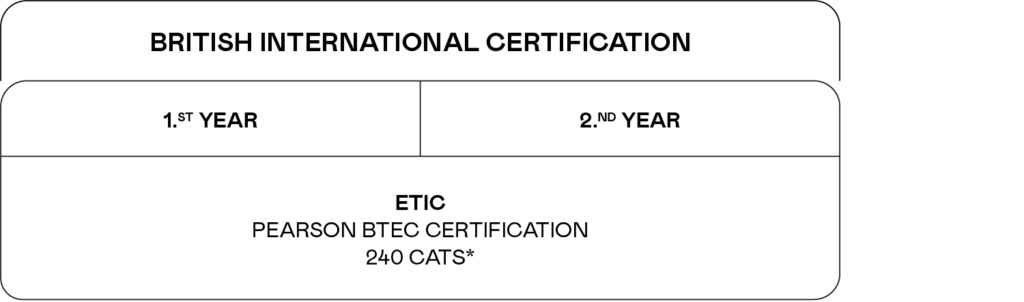
At the end of the second year, students receive the Pearson BTEC Level 5 Professional Certification (240 CATS*).
Certification follows the British education system; ETIC is not a higher education institution.
*CATS: Credit Accreditation Transfer System
TEACHING STAFF
Pedro Vieira
TBC
José Quintela
Joana Caiano
Marta Cordeiro
CAREER PATHS
Marketing, Advertising, and Brand Content sector:
– Advertising and Brand Copywriter
– Brand Storyteller / Brand Strategist
– Content Specialist (Content Writer/Creator)
– Digital Content Manager
– Corporate Communications Writer
Digital and User Experience (UX) Field:
– UX Writer – Digital Content Strategist
– Social Media Content Creator / Writer
– AI Content Specialist (or AI-Powered Content Specialist)
Audiovisual and Entertainment sector:
– Screenwriter / Scriptwriter
– Animation Writer
– Comic Book Writer / Graphic Novel Writer
– Audio Storyteller / Podcast Writer
Gaming and Interactive Narratives Field:
– Game Writer / Narrative Designer
Journalism and Factual Content field:
– Narrative Journalist
– Documentary Writer
Events and Experiential Design Field:
Events Writer / Brand Experience Creator
Consulting and Freelance Work:
– Freelance Writer
– Narrative / Storytelling Consultant
ERASMUS + & INTERNSHIPS
At the end of the programme, and subject to academic performance, students may apply for:
- an international internship through the Erasmus+ Programme;
- a national/international internship or job opportunities for industry placements with partner companies;
Applications are submitted through the Professional Integration Department (estagios@etic.pt).
ETIC provides a digital platform to communicate job offers and employment opportunities from partner companies.
FACILITIES
ETIC is a school equipped with state-of-the-art technology, tailored to meet the specific demands of each area of study and industry.
APPLICATION
The programme is delivered in English. Recommended english entry level: B1*
Requirements
– Submit a motivation letter, outlining reasons for applying and professional goals;
– Submit portfolio or showreel;
– Attend an interview.
How do I start my application?
– Fill in the form by clicking the APPLY button.
– You will receive an email with dates options for your interview.
*According to CEFR Levels. If you would like to take a free online test , please click English Test
TUITION FEES
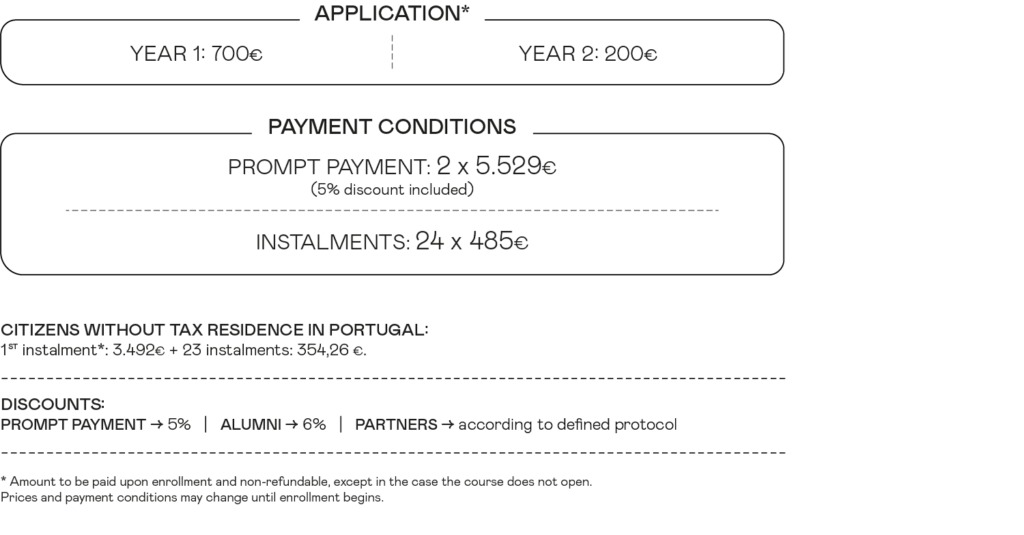
Several banks offer financing programmes to support training and education: Caixa Geral de Depósitos, Santander, Banco CTT, BPI, among others.
TERMS AND CONDITIONS
The opening of each course, class or timetable is subject to a minimum number of enrolments. Enrolment in a specific timetable is limited to the number of available places. Teaching is on-campus and project-based. The course programme includes sessions without a tutor, dedicated to the development of independent exercises and project work. Independent and project-based work is essential to students’ learning progress. Tutors may require students to complete assignments outside scheduled class hours.
Occasionally, classes may be scheduled outside the regular timetable, for example to accommodate projects that require greater flexibility, specific equipment needs, real-world exercises developed with partners, or any other reason that supports the effective delivery of the programme.
Specific technical classes and/or workshops may take place on Saturdays.
The duration of each class may vary depending on whether it is theoretical or practical in nature.
Classes may be divided into smaller groups to enhance learning and intensify the development of projects and course content.
The curriculum and teaching staff may be subject to change for pedagogical reasons or due to circumstances beyond the school’s control.
For further information, please contact us.