OVERVIEW
The music industry is evolving rapidly, and today’s musician is increasingly expected to be an author, songwriter, producer and manager of their own career.
Throughout the programme, students develop songwriting and composition skills, alongside technical knowledge in music performance and music production.
Working in professional recording studios, students gain hands-on experience with analogue and digital technologies, using industry-standard recording software while exploring audio editing, mixing and mastering processes.
With continuous practice, students refine their artistic identity, develop critical listening skills and learn how to define their own creative voice. They have the chance to explore their future roleas as songwriters, composers, music producers or music managers. In this course, students have access to professional recording and production studios, as well as audio post-production and mastering facilities.
PROGRAMME
Music theory is an essential tool for musical creation. Understanding the principles, basic techniques and the terminology underlying music composition and writing will allow us to communicate our ideas more easily to other musicians we work with, as well as to listeners themselves. In this unit, students will discover the basic principles on which contemporary music is built. They will put theory into practice, developing compositional skills in different musical genres, illustrating and demonstrating these concepts on the keyboard or on another instrument. By the end of the unit, students will be able to recognise melodies, rhythms and harmonic elements, understanding their structural function.
The landscape of the music industry has changed drastically in recent years, with technology influencing the way music is produced and consumed, which poses a major challenge for musicians, composers, songwriters and producers, as well as for record labels. This unit allows students to identify the originality of their individual proposal and their strengths, which will make it stand out.
Nowadays, songwriting requires more than ever a versatile set of skills and socio-cultural knowledge. Whether individually or as part of a collaborative project, the writing process in this unit involves a variety of concepts and tools, the practice of which will be developed throughout the lessons. The aim is to familiarise the student with the composition process(es) in order to create their own songs and build their personal portfolio, either as an individual songwriter or as part of a collaborative team.
This unit addresses the music industry as an ever-evolving sector, with a range of areas that overlap with those that previously existed and interact with new ones. In this dynamic, technology-connected context, it is necessary to understand its complexity in order to maximise opportunities that may lead to success in the chosen activity.
Technology is now omnipresent in contemporary music production and a standard tool in the music and entertainment industries. Technological developments have significantly transformed the practice of recording, editing and mixing sound in recent years, and these are the focus of this unit
Versatility is nowadays extremely important for anyone wishing to develop in this field, organising their portfolio and promoting their career using the appropriate marketing and promotional tools. It is important for musicians to acquire knowledge that was previously confined to record labels and managers. These are the topics covered in this unit.
This unit explores the creative possibilities within different DAWs. It will develop skills in areas such as MIDI sequencing and virtual instruments, audio recording and editing, software synthesizers, and mixing using software mixers. It will also begin to develop an awareness of the advantages of certain DAWs in areas such as composition, production, sequencing, audio editing, and post-production.
There are a variety of methods used by sound engineers to work with audio in a safe, controlled, and creative manner. Being a sound engineer involves much more than placing a microphone and pressing Record. Musicians, producers, and sound engineers must acquire all the necessary skills to handle audio in their respective fields, which can range from recording an album to sound design for a film. This unit provides an introduction to these areas.
Performance is one of the most important areas for an artist, band, or musician. In a competitive market, it is essential that their work is presented live: the decline in physical music sales means that live performances now account for a significant portion of revenue, as well as promoting recorded works.
This unit encourages students to explore all aspects involved in preparing and “staging” a live performance, covering both performance techniques and audience expectation management, from rehearsal planning to calculating the commercial costs of the event – such as hiring musicians and technicians and the value of the communication and promotion required.
Upon successful completion of this unit, students will be able to plan, promote, and deliver a high-quality performance that meets the expectations of their audience.
This Laboratory seeks to unify connections among the elements of the community. It is a meeting point and a place for exchanging experiences, a space dedicated to creativity where interdisciplinary practices are explored and developed, both inside and outside the school environment. Communication is the key element in this process. The laboratory aims to identify and mobilize trends, experiment with new ways of thinking and conceptualizing, and facilitate synergies among students. It is a laboratory that presents itself as a learning tool.
Our courses share content and present challenges with an international perspective. We prepare and support our students with best practices in mind, regardless of geography or nationality. For this reason, knowing English is a fundamental tool for breaking down barriers: gaining access to more references, discovering more professional contexts, and developing a portfolio aligned with the best work being produced, without borders.
In this unit, the student will choose their own project based on a proposed theme, allowing them to explore and examine a current topic of notable importance within the context of the Music Production and Creation course.
Audio mixing is a very important process in post-production. In a mix, all recorded tracks are carefully inspected and processed until they sound as desired and relate to each other in a balanced way. The aim of this unit is to provide students with the knowledge and understanding of the techniques used by sound engineers and music producers to combine/mix multiple tracks and layers in order to enhance the final result.
This unit builds on the learning acquired in the “Music Production Fundamentals” unit taught in the previous year. The knowledge previously gained is consolidated and further developed considering current industry best practices. Confident use of technology within the production environment is essential for professional practice in the music and entertainment industries. Speed, proficiency, and workflow, as well as an effective understanding of key techniques and processes, are vital for a successful career.
Over the past two decades, increasingly diverse options have been developed in the use of technologies that provide digital musicians and sound designers with a vast and impressive sonic palette. This unit explores the spectrum of these technologies, the underlying theory, and the sonic capabilities of each, and explains how advanced processing techniques can elevate a raw sound to a higher level.
The aim of this unit is to develop a set of skills in the field of sound engineering for high-quality production in contrasting situations and environments. Upon successful completion of this unit, the student will have supervised two sound engineering projects, from conception to delivery, collaborating with various individuals. The student will then produce two finalised recordings to add to their portfolio and receive critical feedback on the operational success of their projects.
This unit offers students the opportunity, in any artistic and/or technical path, to create a unique portfolio of their work. This portfolio will serve as a calling card for entry into the music industry. The execution of the portfolio, resulting from thorough research and careful finishing and presentation, will demonstrate the student’s skills at the start of their professional journey. The unit provides students with the opportunity to present their work to a panel of industry professionals for feedback prior to its completion.
Working as an artist in today’s music industry requires a diverse range of skills and knowledge. Adapting to a constantly changing world, driven by various technologies such as social media, places greater emphasis on the need to balance the musical universe with commercial contexts. The distinction between the “musical artist” and the “commercial product” has never been more necessary than it is today. This unit prepares the student for the complexities of the industry.
The objective is to prepare students for the project-driven dynamics of the creative industries, encourage teamwork, promote interdisciplinarity, foster a sense of responsibility and goal achievement, and also develop personal presentation and self-promotion skills. In this way, the school environment is brought closer to the reality of the professional world and its demands.
CERTIFICATION
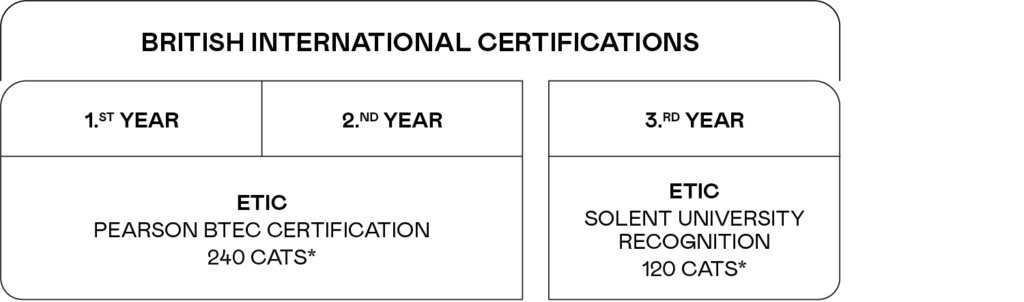
At the end of the second year, students receive the Pearson BTEC Level 5 Professional Certification (240 CATS*).
Certification follows the British education system; ETIC is not a higher education institution.
*CATS: Credit Accreditation Transfer System
TEACHING STAFF
RAFAELA RIBAS
JOÃO GOMES
ANDRÉ PRISTA
MIGUEL ÂNGELO
ANDRÉ PRISTA
FRANCISCO FARIA
SELMA UAMUSSE
SARA ESPÍRITO SANTO
ALEX D'ALVA TEIXEIRA
BERNARDO FESCH
Teacher
BERNARDO FESCH
Professional musician, with a Master’s degree from Codarts University of the Arts in Jazz Performance (Electric Bass).
He also specialises in Music Production and Mixing.
Linked In
CLÁUDIA MARQUES SANTOS
PEDRO VILLAS SILVA
JOHN GONÇALVES
JOÃO BORGES
NUNO ROQUE
PAULO FEIJÃO
MIGUEL BARROS
CAREER PATHS
- Musicians and composers
- Music producers
- Music project managers
ERASMUS+ & INTERSHIPS
At the end of the programme, and subject to academic performance, students may apply for:
- an international internship through the Erasmus+ Programme;
- a national/international internship or job opportunities for industry placements with partner companies;
Applications are submitted through the Professional Integration Department (estagios@etic.pt).
ETIC provides a digital platform to communicate job offers and employment opportunities from partner companies.
FACILITIES
ETIC is a school equipped with state-of-the-art technology, tailored to meet the specific demands of each area of study and industry:
- 2 Sound Studios equipped with Universal Audio, Audient, Tube Pre-amps, AVID Pro-Tools HDX systems, Ableton LIVE (Waves, Fab Filter and UAD plugins). AVID S6 and S3 controllers, Genelec, Adam, M-Audio sound monitors.
- Mixing tables (Midas, Allen & Heath, Behringer and Yamaha). Fostex HD digital recorders, processors (Lexicon, TLAudio,SPL, Yamaha). Microphones (Neumann, Sennheiser, AKG, DPA, Shure, Sanken, Studio Projects). Portable recording equipment (Sound Devices, Tascam and Roland).
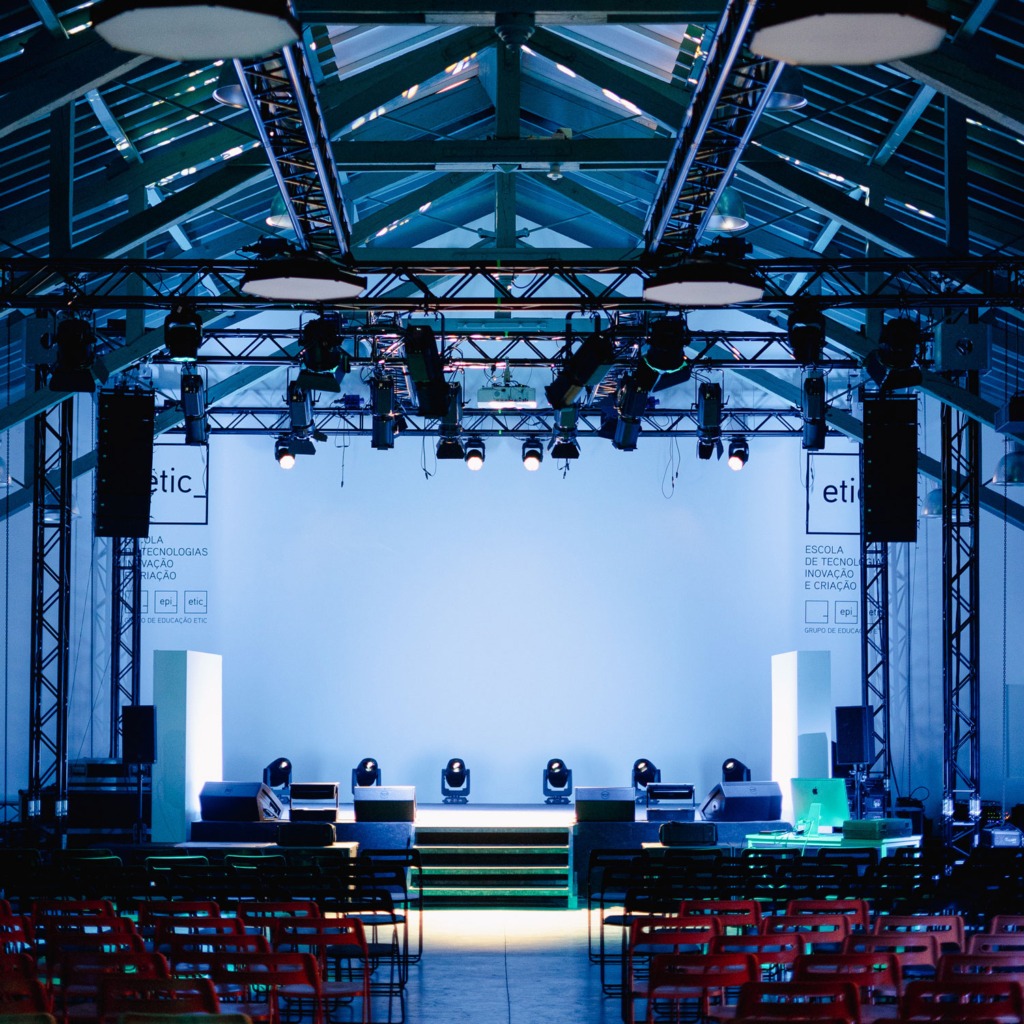
- Concert spaces with stage, PA and Pionneer DJ stations.
- Musical instruments: electric and acoustic guitars, electric bass, acoustic drums (Fender, Stratocaster, Telecaster, Jazz Bass, Yamaha).
APPLICATION
The programme is delivered in English. Recommended english entry level: B1*
Requirements
– Submit a motivation letter, outlining reasons for applying and professional goals;
– Submit portfolio or showreel;
– Attend an interview.
How do I start my application?
– Fill in the form by clicking the APPLY button.
– You will receive an email with dates options for your interview.
*According to CEFR Levels. If you would like to take a free online test , please click English Test
TUITION FEES
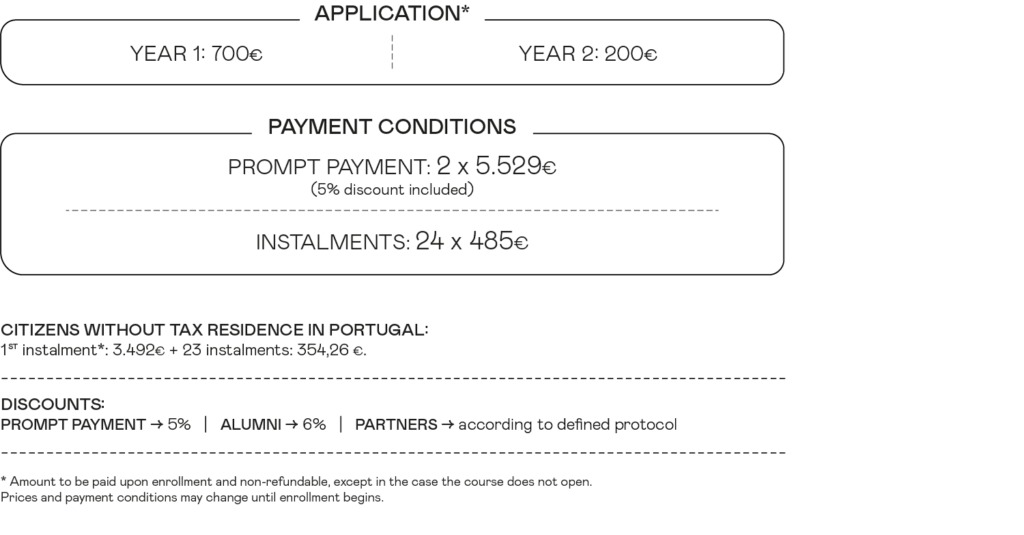
There are several financing programs in different banking institutions: Caixa Geral de Depósitos, Santander, Banco CTT, BPI, among others.
TERMS AND CONDITIONS
The opening of each course, class or timetable is subject to a minimum number of enrolments. Enrolment in a specific timetable is limited to the number of available places. Teaching is on-campus and project-based. The course programme includes sessions without a tutor, dedicated to the development of independent exercises and project work. Independent and project-based work is essential to students’ learning progress. Tutors may require students to complete assignments outside scheduled class hours.
Occasionally, classes may be scheduled outside the regular timetable, for example to accommodate projects that require greater flexibility, specific equipment needs, real-world exercises developed with partners, or any other reason that supports the effective delivery of the programme.
Specific technical classes and/or workshops may take place on Saturdays.
The duration of each class may vary depending on whether it is theoretical or practical in nature.
Classes may be divided into smaller groups to enhance learning and intensify the development of projects and course content.
The curriculum and teaching staff may be subject to change for pedagogical reasons or due to circumstances beyond the school’s control.
For further information, please contact us.
By the end of the course, students are able to create, produce, perform and manage music projects independently or collaboratively, supported by a professional portfolio and a solid understanding of the global music industry.
The Music Production and Creation – International Certification course at ETIC is designed for aspiring and emerging music professionals who want to develop both creative and technical skills within the contemporary music industry.
This international certification equips students with a strong combination of creative, technical and professional skills, preparing them for the realities of today’s music and entertainment industries.
Musical & Creative Skills
Music composition and songwriting across different genres
Applied music theory for contemporary music creation
Development of artistic identity and personal musical language
Creative research and concept development for original projects
Collaboration and co-writing skills
Music Production & Technology Skills
Audio recording techniques in studio and live environments
Use of Digital Audio Workstations (DAWs) for composition and production
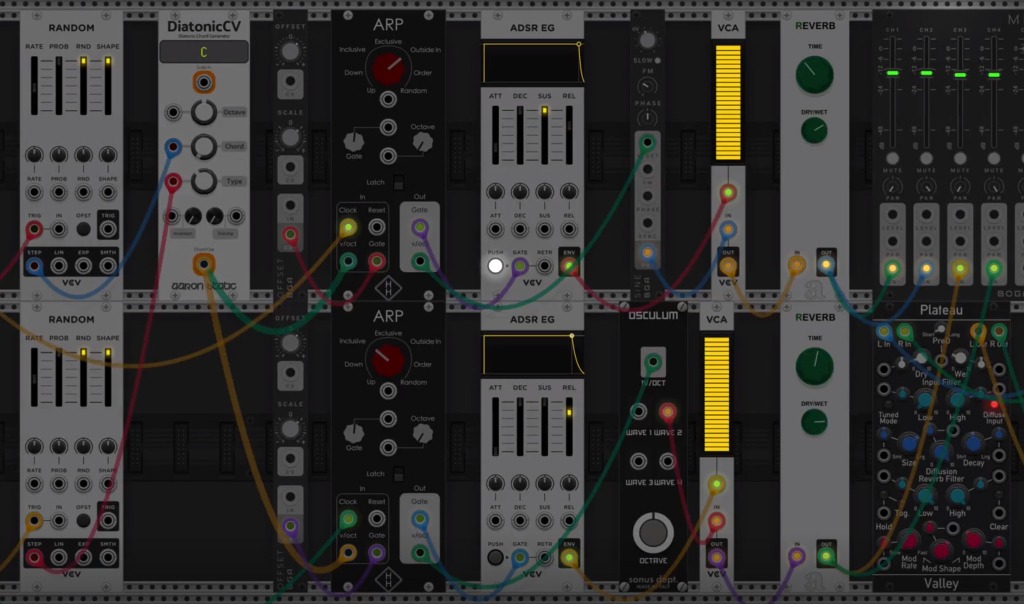
MIDI sequencing, virtual instruments and sound synthesis
Audio editing, arrangement and production workflows
Advanced music production techniques aligned with industry standards
Sound Engineering & Audio Skills
Sound engineering fundamentals and professional practices
Mixing and mastering for different platforms and formats
This programme prepares students for a wide range of creative, technical and entrepreneurial roles within the contemporary music and entertainment industries. Students can work independently, collaboratively or within professional organisations.
Creative & Artistic Roles
Musician / Performing Artist (solo artist or band member)
Composer & Songwriter for music projects, artists, media and audiovisual content
Music Producer for recorded music, independent artists and labels
As an international programme, English is used across all classes; projects and professional activities are set to prepare students for global experience, international collaboration and portfolio presentation within the industry.
Upon successful completion of the second year, students are awarded a BTEC Higher National Diploma, Level 5, carrying a total of 240 CATS credits*.
ETIC has been a Pearson BTEC Accredited Centre (Business and Technology Education Council) since 2016. The programmes have a duration of two years and are internationally recognised, enabling direct entry into the labour market as well as progression to further studies.
The programmes are assigned a qualification level by Ofqual (Office of Qualifications and Examinations Regulation) under the Regulated Qualifications Framework (RQF), which forms part of the UK qualifications system.