PORTFOLIO
Overview
Concept Art and Visual Storytelling for Visual Development, Comics, Animation, and Videogames.
All types of modern media that we consume require an idea, a concept, a key visual, to spark the creativity that will fuel the videogames, movies, animations and comic books that we love and want to be part of. This is a course designed for the artists who envision a professional future within the entertainment industry.
Beginning with the fundamental principles, students will develop essential 2D and 3D skills enabling them to develop the characters, environments and narratives that are the building blocks of these creative productions. From creator-owned projects to studio-level, pipeline productions, you will have the skillset to be part of this industry as a professional artist.
LEARNING METHODOLOGY
The School’s teaching is based on a project-based learning (PBL) approach, delivered in small classes of up to 18 students, ensuring close student-teacher interaction. Students learn by seeking solutions to real-world challenges, often working in teams, fostering their creative, critical, and personal development.
TEACHERS
The teaching staff is composed of active industry professionals, and students are encouraged to participate regularly in workshops, conferences, and study visits to enhance their knowledge and gain exposure to real-world professional environments.
PROGRAMME
Whether you are working on the next major video game, film, original character, animation, or comic book, the creative process must be reliable and consistent. Using methods of ideation, iteration, and execution, you will learn to develop a fully realised and engaging character from a simple idea, one that breathes and lives in a believable world.
Being able not just to produce an image but to tell a story that will resonate with your client or audience is a core skill that will shape your artistic voice and the quality of the artwork you create. You’ll be given the fundamentals of image making and composition to achieve this goal.
In this unit you’ll learn the most fundamental art skills that any artist should be comfortable with: the human figure and its construction, as well as the basics of perspective to understand the world around us and how to translate it from 3D to 2D.
Life drawing classes with models, using multiple mediums and understanding how to deconstruct the human form is a must to any future artist that wants to be relevant in today’s artistic and entertainment industry.
This unit aims to help you get the knowledge to perceive color and light through painting. Using digital mediums you’ll be asked to paint and understand materials and how light interacts with objects around us, while developing your inner artistic voice.
Using Blender you’ll learn the basics of modelling, texturing and lighting to help your concept design projects achieve the level of rendering and detail expected and applied to professional pipeline workflows.
Understanding the pre-production and development history of a movie, video game or product, will give students the opportunity to learn about design choices, shape language, synthesis and artistic decision making that sets apart generic content from inspired artwork.
Students will learn how to approach the industry with their artwork and projects, in a structured, professional and confident manner.
In this unit, you’ll be asked to develop a personal project that not only responds to a briefing but also promotes your artistic identity and problem solving core skills to give you a set of artwork pieces that will be featured in your portfolio.
This Laboratory aims to unify connections within the community. It serves as a meeting point and space for exchanging experiences, a place dedicated to creativity where interdisciplinary practices are explored and developed both inside and outside the school environment. Communication is the key element of this process. The lab seeks to identify and mobilize trends, experiment with new ways of thinking and conceptualizing, and facilitate synergies among students. It is presented as a learning tool.
Our courses share content and present challenges with an international perspective. We prepare and support our students based on best practices, regardless of geography or nationality. For this reason, knowing English is a fundamental tool for breaking down barriers: gaining access to more references, discovering more professional contexts, and developing a portfolio in line with the best work being produced, without borders.
To develop your design solutions further, you’ll learn how to connect characters to cultures, cultures to objects and traditions to locations achieving believable world building and relevant background to your stories and narrative decisions.
In this unit you’ll learn the connective tissue of a story, the building blocks and structure to any narrative thread. How to set a plot, to engage with your audience and to achieve a conclusion, either in a single image or sequential form.
Students will be asked to push further their mark marking and interpretation of the figure, form and space. Synthesis, shape language and design decisions applied to real world elements that will fuel their artistic voice and future projects.
In this unit, we will tap into our notion of style, what it means to you and if it showcases your strengths and core values. We will use advanced painting and image manipulation techniques to achieve a process that is both effective as well as unique to you.
Using sculpting techniques, students will be asked to create 3d assets that will be used as design reference or as components in the workflow pipeline of their work.
After understanding how to create 3d assets, you’ll learn how to integrate these assets into game engines. Using this powerful tool, you’ll be able to create dynamic sets with lighting, composition and key poses to achieve engaging concept design choices.
In this unit, you’ll be asked to create designs with applied knowledge combined with critical contextual feedback, to produce work aligned to a briefing that reflects real world professional client work.
You’ll be asked to create a portfolio that takes advantage of the industry insiders and professional feedback that the course staff has available (and guests), to set yourself on the right path to your professional endeavors and personal goals.
The objective is to prepare students for the project-driven dynamics of the creative industries, encourage teamwork, promote interdisciplinarity, foster a sense of responsibility and goal achievement, and develop personal presentation and self-promotion skills. In this way, the school environment is brought closer to the reality of the professional world and its demands.
CERTIFICATION
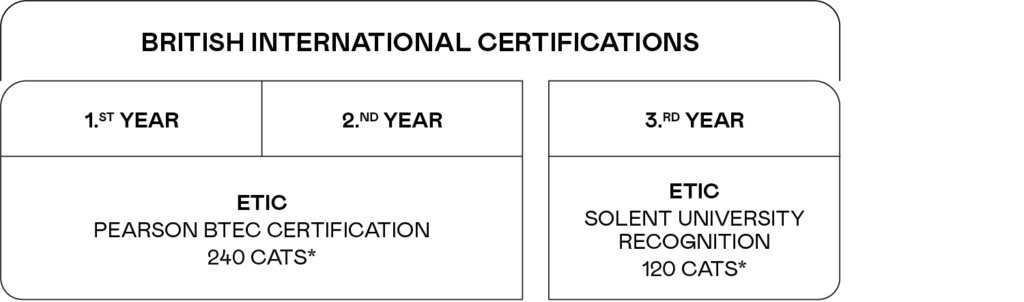
At the end of the second year, students receive the Pearson BTEC Level 5 Professional Certification (240 CATS*).
Certification follows the British education system; ETIC is not a higher education institution.
*CATS: Credit Accreditation Transfer System
TEACHING STAFF
Tiago Lobo Pimentel
Joana Muge
Ivan Barroso
Ricardo Toureiro
Bianca Millanez
Luís Soares
CAREER PATHS
- Animated Film Director
- Animator
- Storyboard Artist
- Art Director
- Character Designer
- Environment Artist
- Layout Artist
- Producer
- 3D Artist
- Project Coordinator
- Compositing Artist
ERASMUS+ & INTERNSHIPS
At the end of the programme, and subject to academic performance, students may apply for:
- an international internship through the Erasmus+ Programme;
- a national/international internship or job opportunities for industry placements with partner companies;
Applications are submitted through the Professional Integration Department (estagios@etic.pt).
ETIC provides a digital platform to communicate job offers and employment opportunities from partner companies.
FACILITIES
ETIC is a school equipped with state-of-the-art technology, tailored to meet the specific demands of each area of study and industry:
- Digital Drawing tablets;
- Adobe Creative Suite (Photoshop, After Effects)
- TVPaint;
- Blender – 3D software or Autodesk Maya.
APPLICATION
The programme is delivered in English. Recommended english entry level: B1*
Requirements
– Submit a motivation letter, outlining reasons for applying and professional goals;
– Submit portfolio or showreel;
– Attend an interview.
How do I start my application?
– Fill in the form by clicking the APPLY button.
– You will receive an email with dates options for your interview.
*According to CEFR Levels. If you would like to take a free online test , please click English Test
TUITION FEES
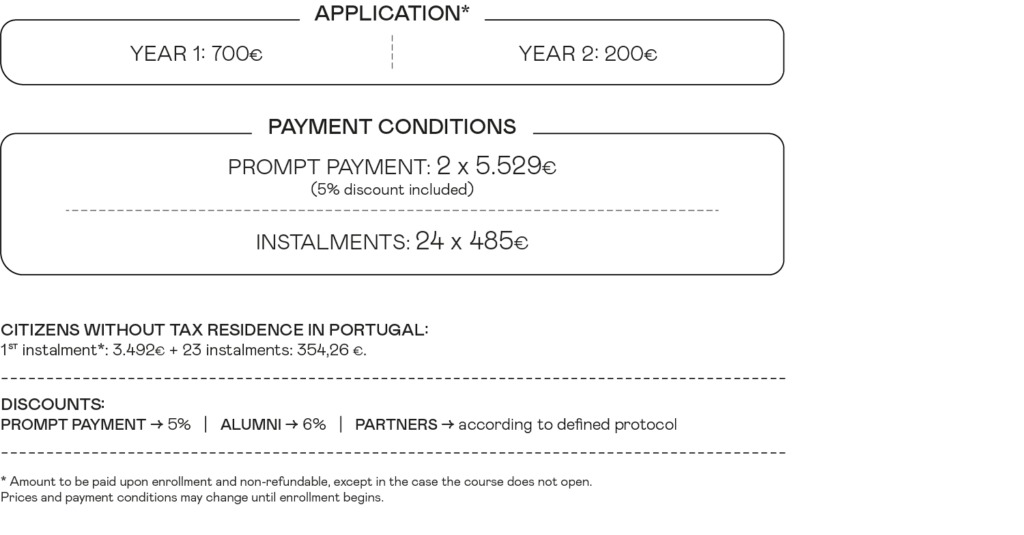
Several banks offer financing programmes to support training and education: Caixa Geral de Depósitos, Santander, Banco CTT, BPI, among others.
TERMS AND CONDITIONS
The opening of each course, class or timetable is subject to a minimum number of enrolments. Enrolment in a specific timetable is limited to the number of available places. Teaching is on-campus and project-based. The course programme includes sessions without a tutor, dedicated to the development of independent exercises and project work. Independent and project-based work is essential to students’ learning progress. Tutors may require students to complete assignments outside scheduled class hours.
Occasionally, classes may be scheduled outside the regular timetable, for example to accommodate projects that require greater flexibility, specific equipment needs, real-world exercises developed with partners, or any other reason that supports the effective delivery of the programme.
Specific technical classes and/or workshops may take place on Saturdays.
The duration of each class may vary depending on whether it is theoretical or practical in nature.
Classes may be divided into smaller groups to enhance learning and intensify the development of projects and course content.
The curriculum and teaching staff may be subject to change for pedagogical reasons or due to circumstances beyond the school’s control.
For further information, please contact us.
It is a professional course with International Certification focused on concept art, visual storytelling and portfolio development for games, film and animation industries.
This programme is designed for aspiring concept artists and visual storytellers who want to develop strong artistic foundations and professional skills for the creative industries. It is particularly suited to students interested in character design, environment design, visual development, and world-building for games, film, animation, and digital media.
Basic drawing skills are recommended, but the course starts from foundational principles and develops progressively. The level of complexity increases gradually, ensuring that students develop skills, confidence and autonomy while being supported by close mentoring and guided project development.
Key skills developed include:
- Concept art and visual development skills, including character design and environment design.
- Creative ideation and problem-solving, using structured processes of ideation, iteration, and execution.
- Visual storytelling and image construction, focusing on composition, visual hierarchy, and emotional communication.
- Strong drawing fundamentals, including anatomy, perspective, construction, and observational drawing.
- Digital painting techniques
- Understanding of colour, light, and atmosphere to create visually consistent and believable worlds.
As an international videogame art and animation programme, English is used across all classes; projects and professional activities are set to prepare students for global studios, international collaboration and portfolio presentation for the worldwide videogame industry.
Upon successful completion of the second year, students are awarded a BTEC Higher National Diploma, Level 5, carrying a total of 240 CATS credits*.
ETIC has been a Pearson BTEC Accredited Centre (Business and Technology Education Council) since 2016. The programmes have a duration of two years and are internationally recognised, enabling direct entry into the labour market as well as progression to further studies.
The programmes are assigned a qualification level by Ofqual (Office of Qualifications and Examinations Regulation) under the Regulated Qualifications Framework (RQF), which forms part of the UK qualifications system.
*CATS: Credit Accumulation and Transfer Scheme.